WT IFTTT

I automated my Facebook birthday messages based on the contacts in my google calendar. Social media  takes the personal aspect out of a birthday wishes as it is, so I thought I would just automate them completely so I wouldn’t have to think about it.

Tweet WT found interesting

One tweet that I found interesting was shared by our very own Golan Levin. It’s a traffic light installation piece. The reason I find it very interesting is because the piece itself shows promise of being accessible to many people, considering it lies outside of a gallery context. I want to experiment more with public art in future assignments.

Fun traffic light installation / public artwork https://t.co/vphGaGLbTG

— Golan Levin (@golan) September 3, 2014

Looking Outwards 2 – WT

ADMIRE: CacheFlowe and Rachel Murray – Triangulated Gem Projection Mapping

This video installation piece is really well executed, in my opinion. I admire this work because this is the kind of project I’d love to make. I think that digital art can create a captivating experience for the viewer when paired with the right electronic music. I want to create an experience like this.

SURPRISED: BassShapes – YellQuietly

This project surprised me by showing me the potential of audio-reactive visualizations. Before seeing this, or being in this class really, I had no idea that there were resources I could use to make this type of art. I’m really excited to see what I can make, given the time and resources.

http://yellquietly.com/bass-shapes/

DISAPPOINTED: “Je Pars” – Directed by Hugo Arcier

I think that the animation/digital manipulation in this video is very interesting and cool. However, I think that a good music video requires a little more substance than this one currently offers. It’s probably better if the special effects aren’t the only aspect backing the video, but used as an enhancement.
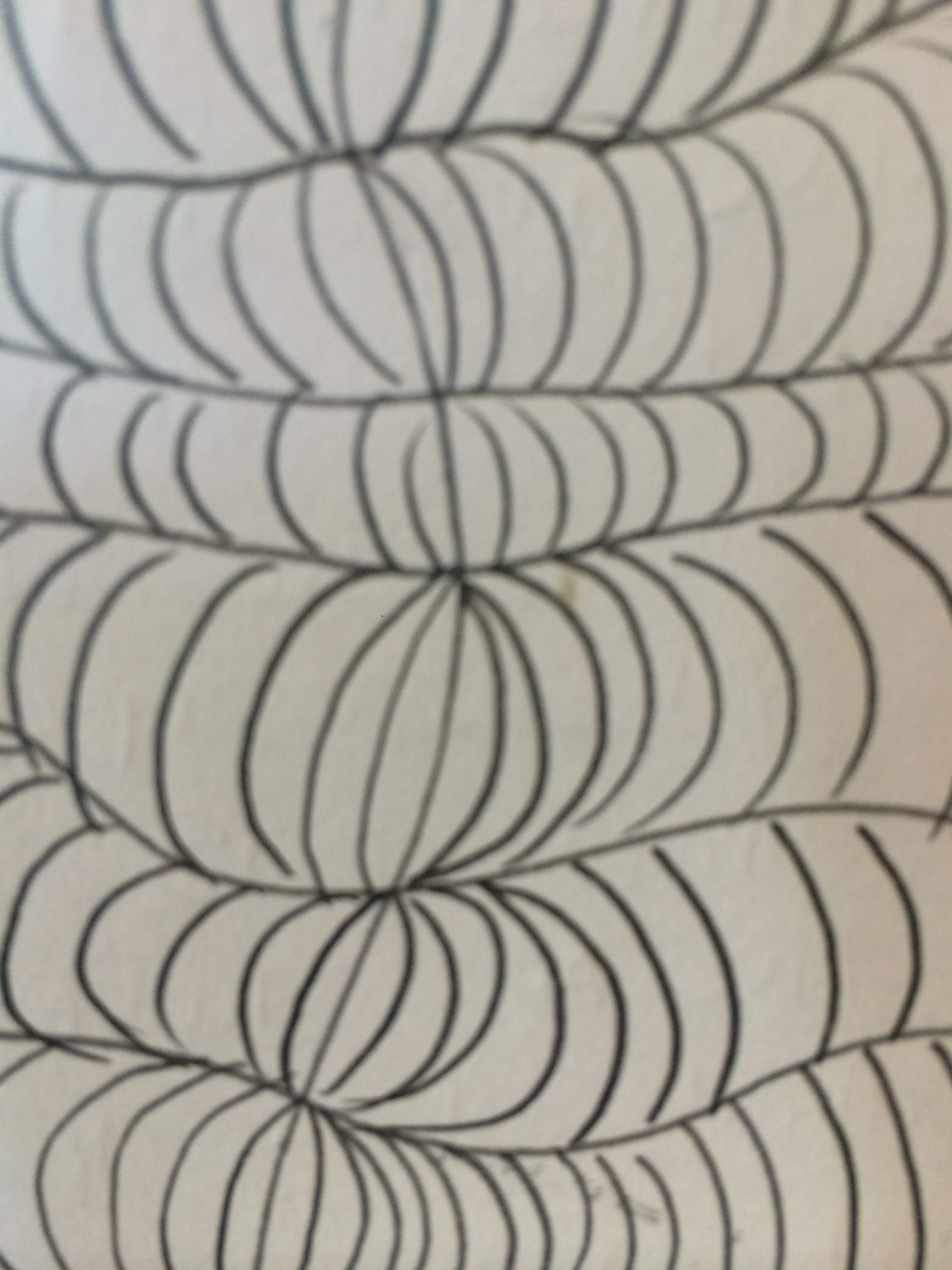
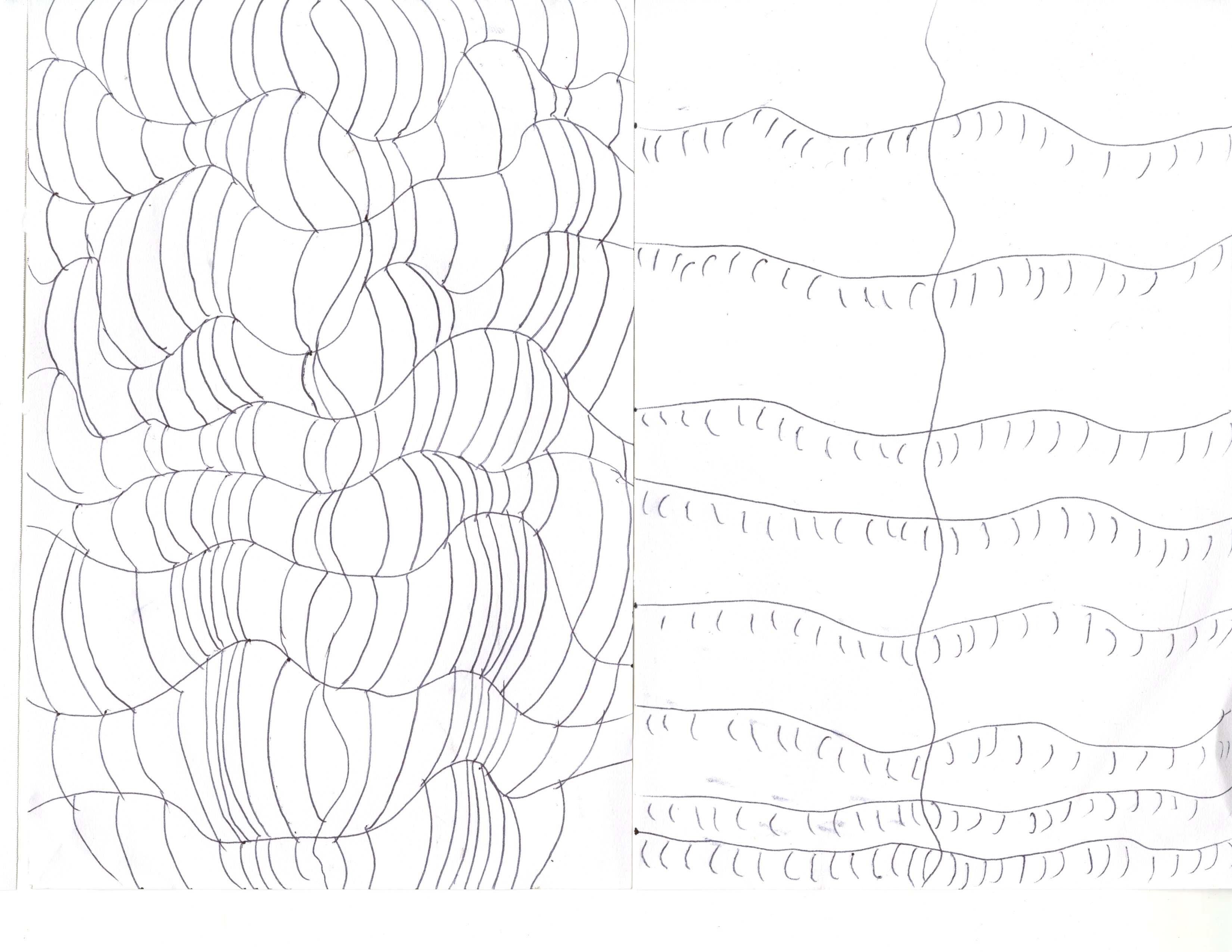
Instructional Drawing: Make an optical illusion

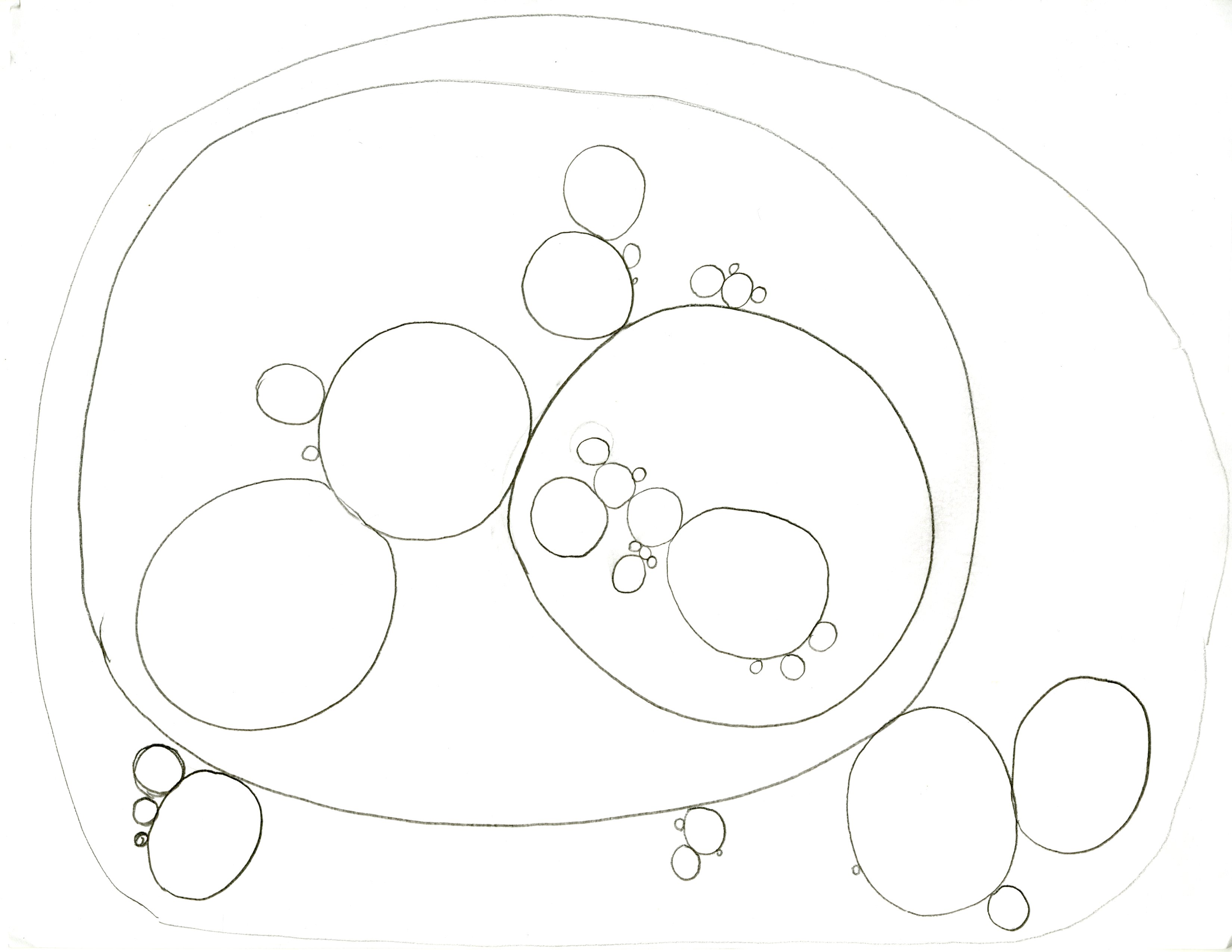
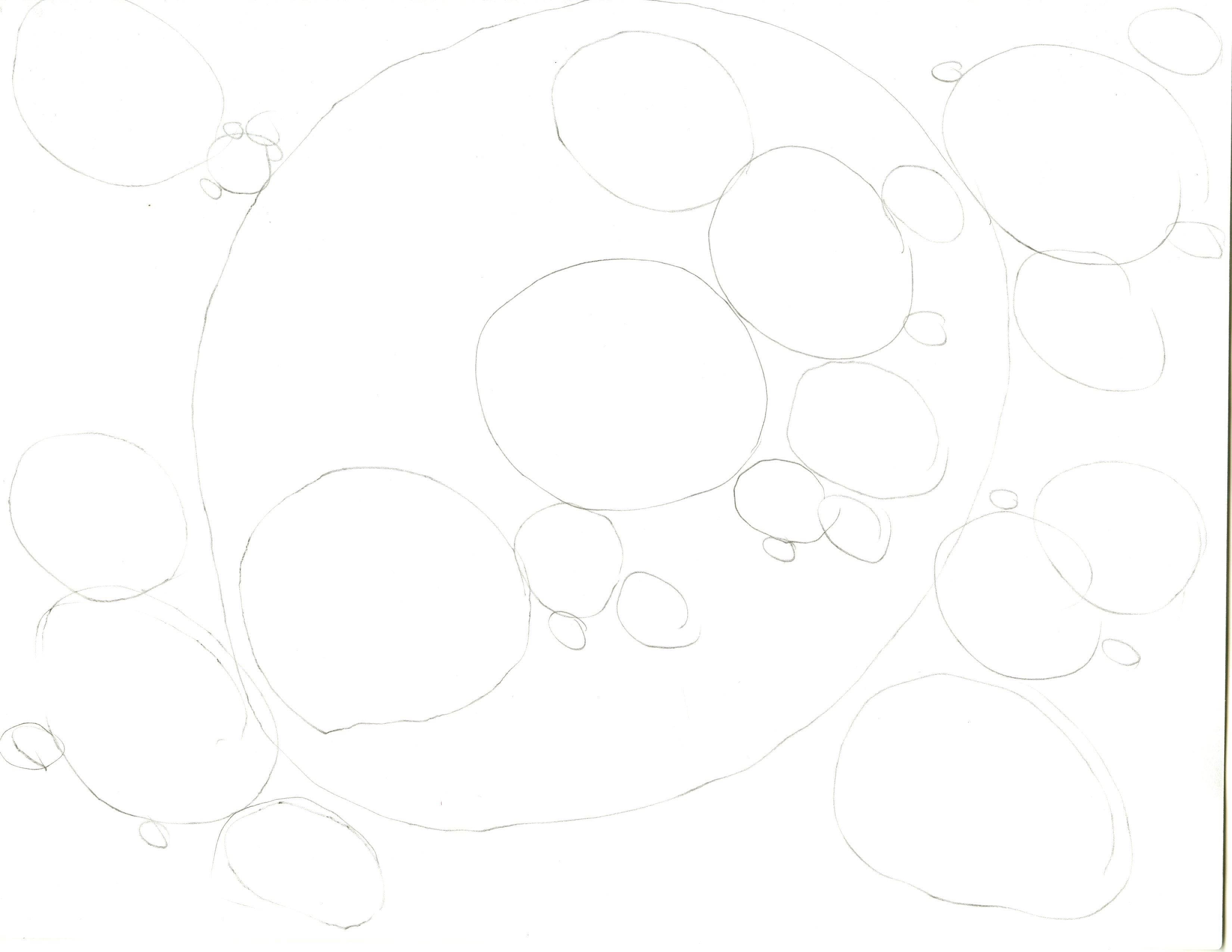
I wanted my doodlers to be happily amused by following my process that should result in a cool optical illusion. Some were pleased with the outcome while some found my rough instructions confusing.

This first photo is how I anticipated the drawings would come out. The later are my IMG_2845img001directions and audrey002directions and the 3 drawings that were produced

Wall Drawing

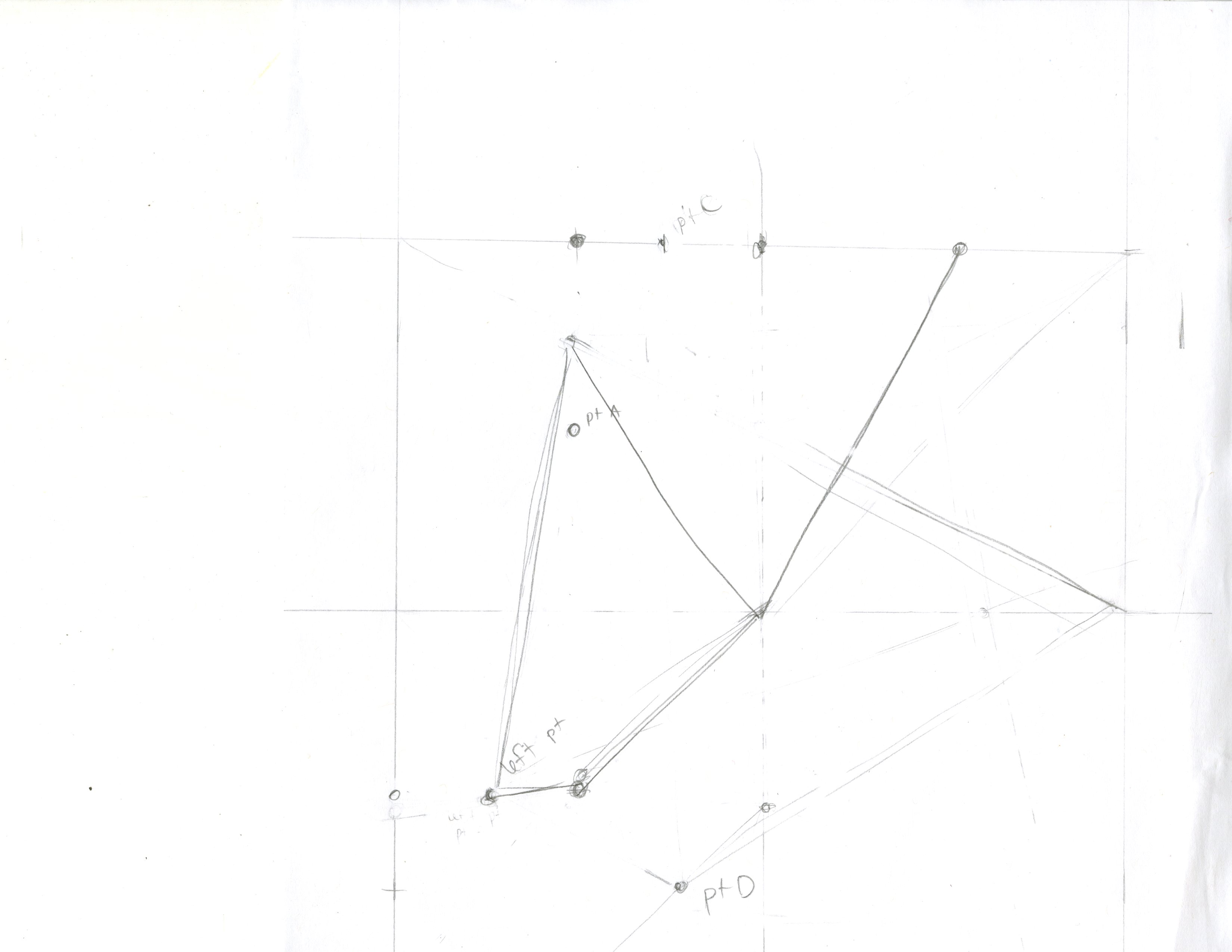
So back in the 70s, Sol Lewitt took great pleasure in torturing gallery assistants by ordering them to make his art for him. Not only this, but Lewitt found it necessary to give his commands in the form of one unintelligible run-on sentence. In one such wall of text, Lewitt instructs the creation of a trapezoid which follows a very specific set of proportions, given in his signature unintelligible babbling style.

Needless to say, I executed his muddled and ill-conceived procedure flawlessly:

Sol Lewitt's Trapezoid Sol Lewitt’s Trapezoid

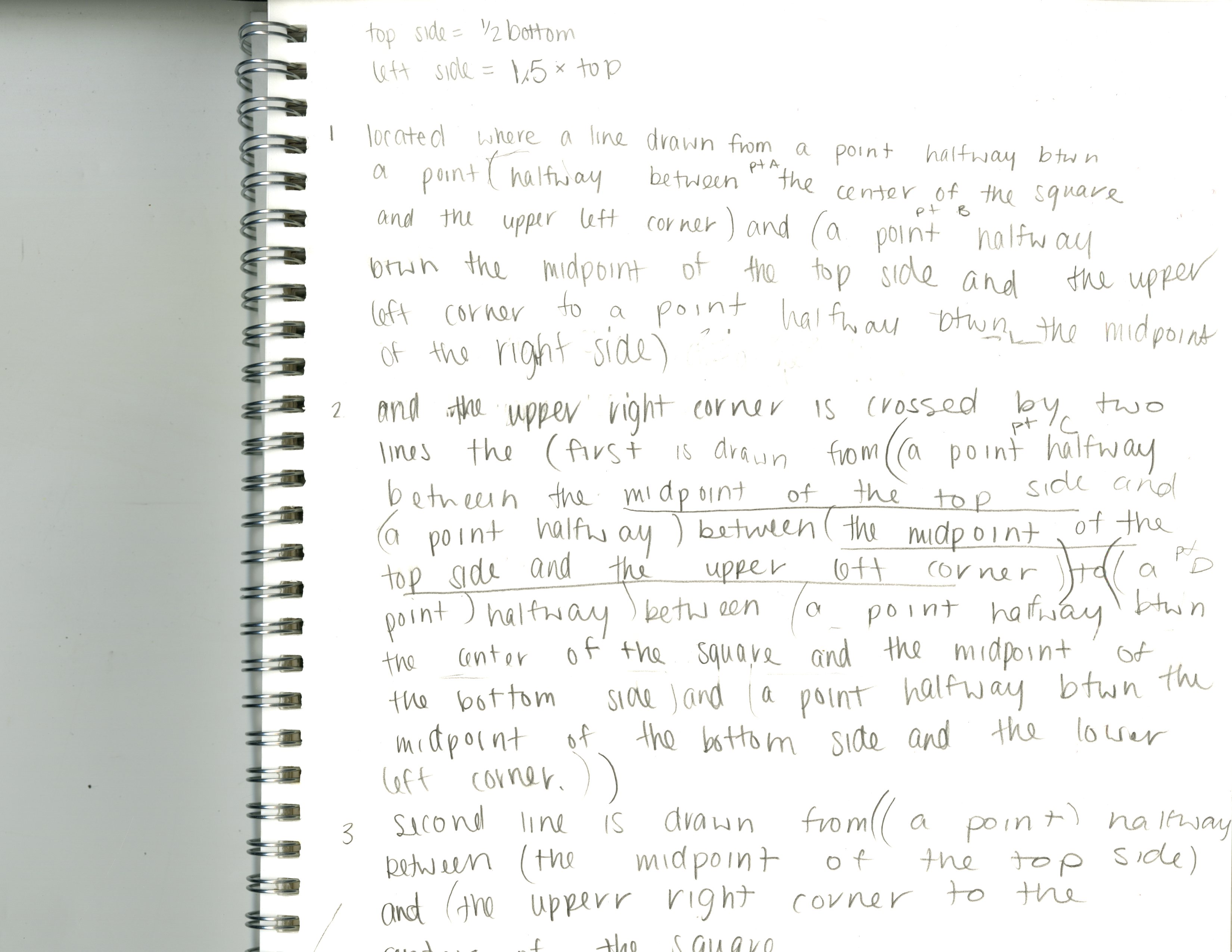
In order to understand Lewitt’s cryptic commands, I broke them down into mathematical equations, as seen below the drawing itself. I found this to be the most effective tactic for extracting useful properties of the trapezoid from sections of the sentence.

Instructional Drawings


1)   Draw a circle in the center of the page.

2)   Draw 3 circles, of different sizes, that are tangent to the old circle.

3)   Each new circle should then have a set of 3 more circles, of different sizes, drawn tangent to it.

4)   Draw a circle around the entire form.

5)    Repeat steps 2-4, adding one more circle to steps 2 and 3 for each new cycle, until page is full

img003 img005 img006 img004This assignment was also quite tricky because I tried to devise a set of 5 instructions that would create a random pattern.  And unlike the cycle example shown in class, I wanted to expand the form instead of constricting it.  My first few drafts of the instructions had people drawing circles encompassing other circles kind of like a cross section of onion layers.  Therefore, I had to sit down and thing about specific words that meant touching two circles without engulfing one another.  Finally I reached the conclusion of the word “tangent”.  from then on all the drawings started looking the way I intended then to look. I was surprised that some people interpreted tangent as putting the circle inside the first circle rather than outside. I think that in the future, I would add an instruction that would allow the drawer to fill in the empty space. that appeared in many of the drawings.


My trapezoid


I don’t consider Levitt’s instructions to be code. The first picture I posted is one page of notes in which I tried to apply code-like thinking in order to make sense of Lewitt’s directions. I feel that because his text seemed purposefully confusing this is not code. Good code, to me, is clear and written with the goal of consistent function. directions and audrey004directions and audrey005

Assignment-02-IFTTT. Now I get to see space more.

I used IFTTT to see more of our fine galaxies! Everyday when NASA posts their astronomy photos of the day I immediately get to see them. For me IFTTT has been a good way for me to see beautiful things I wouldn’t normally. I also subscribed to a cloud observational website IFTTT so I could see beautiful natural sensations.

IFTTT so far has been a very good experience I enjoy the concept of the site so much too. Applying if-like statements to my internet experience will help cut my browsing down as I’ll get real-time updates from the things I want to see.

Written by Comments Off on Assignment-02-IFTTT. Now I get to see space more. Posted in Assignment-02-IFTTT

WT Lewitt drawing

EMS Trapezoid


While following the instructions for the drawing, I found it very difficult to distinguish separate points in a single sentence. I think that these instructions could be considered code, but as code they’re very complex and difficult to understand. Especially if they are being given to a human to decipher. One thing that really helped me was breaking the sentences into expressions, as seen at the top of the page.