The Lady’s Glove

LAETITIA SONAMI (FR/US): LADY’S GLOVE (II) from kontejner.org on Vimeo.

Laetitia Sonami’s The Lady’s Glove weaves together performance, technology, interaction, and sound into one. Through a system of sensors, microphones, and stylish mesh, the glove generates sound by measuring distance, light, and motion relative to the artist’s hand in performance. These measurements are mapped using MAX-MSP and are converted to sound or light. The object has a unique relationship to the artist, evolving with her over the years to fit her performances. I enjoy this intimacy between art object and creator and how this translates to Sonami’s interactions with her glove while performing; I also enjoy the cross over of media within art. Sonami created the first three iterations of the glove with Paul DeMarinis, but the current and previous versions were created by Bert Bongers. Bongers fabricated the gloves along Sonami’s original designs, but updated the sensors and equipment for the changing technologies of the day. Sonami’s current glove was built in 2001. This work is an example of the artistic uses of sensors in motion and foreshadows further exploration of interactive performance.

CE Manifesto

5. The Critical Engineer recognises that each work of engineering engineers its user, proportional to that user’s dependency on it.

This tenet points out the irony especially present in modern civilization wherein technology conditions and controls the user to an extent, rather than the users exerting exclusive control over technology. This claim is interesting because it can be both dangerous and helpful. As Henry Thoreau observed, when we become the “tool of our tools”, we can lose focus on a fulfilling life. However, the Critical Engineer can also exploit this for further progress. For example, as more and more people are gaining access to mobile internet, they become more dependent on the mobile device for things like news and social connection. This dependence ensures that conveniences like satellite navigation on mobile devices will not go wasted.

Rachel-LookingOutwards-1


Light House from SOFTlab on Vimeo.

1. Light House is an interactive spatial environment in which a suspended form of tube light bulbs responds in real time to music. The work was made by SOFTLab, a design group out of New York, using Arduinos, custom hardware, and Processing to control the lights.

I found this work especially beautiful and admirable because it creates its own space of experience, deepening the viewer’s immersion within the work. Though I enjoy the simplicity of the piece, I think pushing the viewer’s emotional ties to the music with the color of the lights and varying the light intensity could strengthen the work.  The music is limiting and simple; adding a way to generate one’s own sounds or providing more abstracted noise would allow for greater conceptual connections.

After looking through SOFTLab’s previous pieces, this work seems like the logical progression of their ideas.  Many of their previous designs include the use of light and the engagement of the surrounding space, asserting the presence of the work over the space as opposed to incorporating the space into the work. This is evident in Global Concepts and in their design for the Beaux Arts Ball with the theme of Tender.

Timelapse of 3D Print Job – Listening to the Ocean on a Shore of Gypsum Sand from Phillip Stearns on Vimeo.

2. Listening to the Ocean on a Shore of Gypsum Sand is an interactive sculpture created by 3D printing mathematically generated patterns of seashells for the express purpose of using them to listen to the ocean. The work was a collaboration between Gene Kogan, Phillip Stearns, and Dan Tesene and used Processing and the Hemesh Library to make 3D models.

This work surprised me in its full exploration of the idea of work and futility. I expected the work to be more focused on the process of creating the shell, but the work extends much deeper. In my interpretation, these perfect mathematical objects are created in desire for a simple, childish moment. The objects could have been any mathematical shape, much more abstract, or finely attuned for harboring the ocean sound. Instead the objects yearn for the organic, relying on patterns of nature to achieve its goal. This is futile because either fabricated or real, the sound of the ocean is generated by the noise around the hollow object, not the object itself.

Gene Kogan has previously combined sound and 3D printing in Audio Sculptures, using sound as form in that instance. I feel that Listening to the Ocean on a Shore of Gypsum Sand is a progression of this content.

3. Aaron Koblin’s Flight Patterns is a data visualization of the frequency of flight paths in The United States. The work utilizes data from the U.S. Federal Aviation Administration compiled with Processing and edited with Adobe After Effects and Maya.

Flight Patterns achieves its job on a literal level, but I feel it was a missed opportunity to make a statement. I find no significance in the colors used to indicate flight densities nor the simple lines tracking each flight. There is no way of telling a commercial flight from a military one. The information only shows flights landing and leaving the United States; there is no indication of the impact of American flights on other places, nor vice versa. There is no environmental data provided.

Some of these questions are addressed in other versions of Flight Patterns. One incarnation shows the paths of all of one model of airplane within the United States. This version does provide more interpretive data than the original.
The Critical Engineer…

“6. The Critical Engineer expands ‘machine’ to describe interrelationships
encompassing devices, bodies, agents, forces and networks.”

The most interesting line for me was line six; it is more interesting to understand machines based on how they work, how their mechanism are connected to each other, how they can connect to each other and how this can be used or exploited. For example, you see this many times in gaming where a fan would simply buy a game and use it whereas other fans would immediately open the game to hack it and release a hacked version onto the internet, often times much more interesting than the original.  In this case, this fan saw the game as something to be explored and changed rather than simply taking it for what it was.

EYJAFJALLAJÖKULL

(pronounced like this)

EYJAFJALLAJÖKULL from ANTIVJ is a visual label on Vimeo.

I was introduced to projection mapping when my architecture major roommate mentioned it to me last semester during our daily swapping of class stories when we weren’t too tired. I saw couple of videos on what she meant by “projection mapping,” and I was mind-blown. Maybe it was my incredible love for all things cubic and glowing, but I remember looking it up a lot online and recalling an image I saw once that resembled a unique form of projection mapping, which I hadn’t had a name for at the time. I hunted down the image, and then managed to find the video of the work. I’ve since seen that digital landscape in my daydreams. It’s probably my obsession with TRON or Digimon from my childhood creating my bias for the work.

But I mostly admire it because it showed me a future for myself, that I didn’t have to abandon drawing in order for me to engage in abstract computational works that appealed to me. I am at my most comfortable when drawing, but at my most frustrated mode at the same time because my ideas feel dead to me when I practice the craft. I am at my most uncomfortable when coding, but at my most enlightened mindset at the same time because these ideas feel fresh and tingly. To combine both crafts like Lemercier did–to invite someone to a space that recurs in my head, to an imagined, otherworldly environment that I feel free to draw but caged when trying to “render” it–is powerful and inspiring.

Since another thing I’m passionate about is game design, Lemercier’s work presents opportunities in projected gaming space, not just a virtual reality, restricted by four corners of a monitor. I am interested in what abstract visual games like The Sense of Connectedness (Michael Brough) or flOw (Jenova Chen) would look like when projected not in front of you, but all around you, so that it is not merely a projection but an environment. I’m pretty sure Lemercier did not have gaming in mind when creating this project, but it’s been cooking in my mind for a while now. It doesn’t even have to be for games though; just imagine this kind of unearthly landscape (yet familiar to us) surrounding your every being. You aren’t just viewing it, you’re there on the precipice, about to fall into the abyss (that sums up my Grand Canyon experience).

In terms of manpower, it seems the installation was entirely done by Joanie Lemercier with additional help from AntiVJ, a group of five artists and one musician. Lemercier came up with the concept and drew the landscape and directed the lights; the artist from AntiVJ, Simon Geilfus, helped with the visuals. Nicholas Boritch, another artist from the self-proclaimed visual label, helped with the production and coordination in order to make the installation happen.


Disillusionment

First word art time period is equivalent to the Peak of Inflated Expectations, because technology and art in that area are not well understood and thus could not be judged by existing standards, they become idealized with too much hype, thus causing the Peak of Inflated Expectations. On the other hand, last word art is equivalent to Plateau of Productivity, where rules and understandings are now grounded in reality, so people can start producing them en masse.

I prefer to start on new technologies after the initial wave of hype and idealism has passed, so my interest lay somewhere after the start of the Slope of Enlightenment. This would be equivalent to being somewhere near the start of last word art.

Schulze prefers Trough of Disillusionment because it provides the perfect balance; we understood enough about the technology to not be misled by idealism, so he does not have to spend time personally conduct experimentation, yet at the same time there are plenty of opportunities that can be taken before the bandwagon rolls in.

Addict

“5. The Critical Engineer recognises that each work of engineering engineers its user, proportional to that user’s dependency upon it.”

Some time ago, I went on a trip with my family. We drove for hours, so we had plenty of time to chat, listen to music, and enjoy the sceneries passing by. By end of the day we reached our hotel, and the moment I got into my room, my laptop sprang into my hand, and 3 Google Chrome tabs flew out to open my email, cnn.com, and Facebook. I need to catch up on all the information I had missed in those hours of non-connectivity. But in fact I just cut connection from my family and my immediate surroundings. “Catching up” to all the information is just an excuse; I am just an addict.

The more we rely on technology, the more it controls us. I am already affected by it, and chances are, I will one day be taking part in its evolution. I need to know what I am getting myself into.

The Crowning Expectation

Both the Gartner Hype Cycle and the First Word/ Last Word analysis are interpretations of society expectations. The Hype Cycle takes a more quantitative, objective view, determining humanity’s interest in technologies based numerical data collected from the technology’s emergence and reaction. First Word/ Last Word looks at emerging art in a similar way: initially, the viability of a newly birthed medium is often questioned, just as a newly emerging technology rank low in expectations on the Hype Cycle. Over time the medium and the technology rise along the expectation curve as audiences become more interested in their functions and applications. Both reach a peak in expectations, during which time the Last Word artwork or crowning refinement of the technology is created. Expectations of improvement plummet due to the Last Word’s success, but the medium/technology is still in use. Gradually the method resumes some of its former expectations as it reaches a mainstream level.

I think Schulze prefers working in The Trough of Disillusionment because the technology/medium takes on new connotations and conceptual value as a symbol of society with its fall from glory. For example, what once was only available only to the wealthy can now be accessed by the masses. I tend to build from established tools, so I too prefer to work from the Trough.

Consequences of Implementation

4. The Critical Engineer looks beyond the ‘awe of implementation’ to determine methods of influence and their specific effects.

Tenet four of The Critical Engineering Manifesto denotes a time especially important during the formation of art.  To understand and engage in the dialogue of the work, and artist must anticipate its reaction among viewers. This is the way the artist progresses through his or her creative process: listening to the intentions, the decisions of execution, and the possibilities of impact of the work. The process is similar to testing code for bugs and tweaking its meat until it fulfills the desired or newly discovered purpose. I find this parallel process interesting. A programmer and an artist must be aware of the potential positive or negative effects of their creations on the world. Technology and art are open ended and their uses vary between users.  My uses for a cell phone are generally benign, though mobile phones can be used as spying devices or detonators; In this way the residue of one artwork could drive me to re-evaluate my life goals, but the same work could bring another peace of mind.

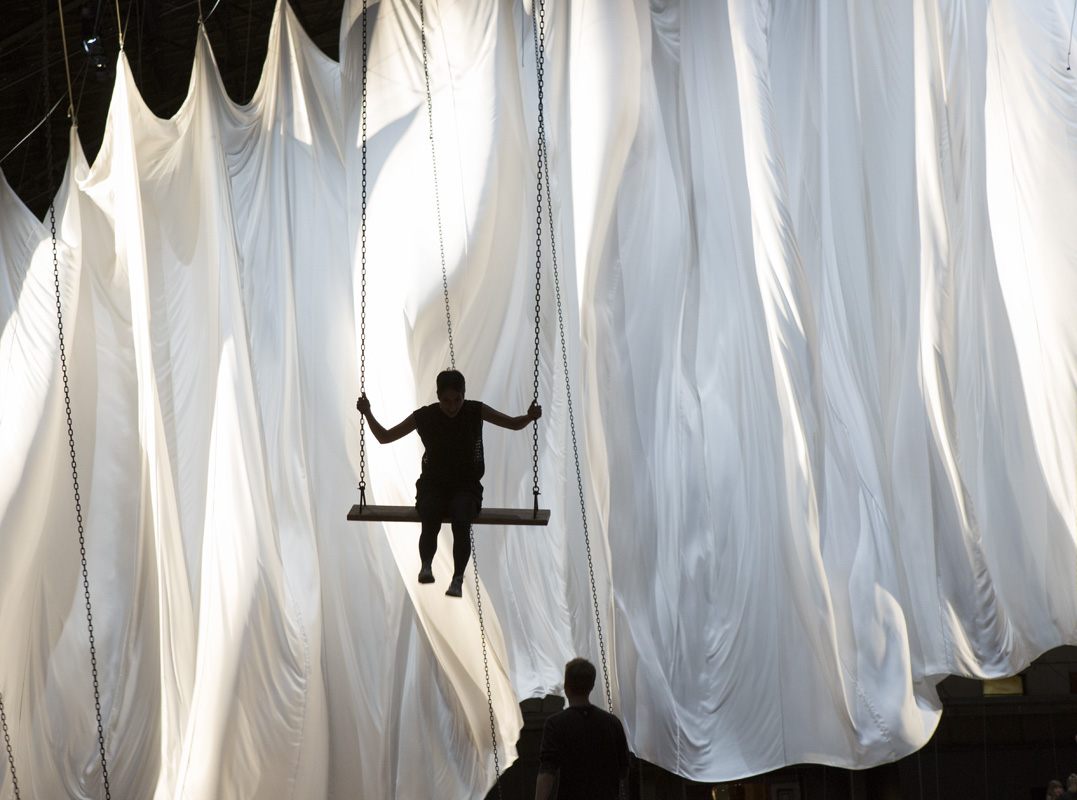
Anne Hamilton – “The Event of A Thread”

PAA_Ann_Hamilton_JamesEwing

Ann Hamilton is a well known artist who in 2012 exhibited her installation “The Event of a Thread” in New York city. The exhibit was highly interactive and featured large curtains that fell down and was propelled by machinery into calm soothing waves. The art piece also had various swings that were just as long as the curtains that the audience could sit on in order to control the curtains. Amidst this, a lone performer sits on a desk and pretends to be a writer as he listens to the speaking of a woman. Although I could not find exactly how many people were involved in the making of this piece, I have found that Ann Hamilton outsourced many of the materials she needed to be made for this project. For example, she gave Rose Brand Sewing a custom job to create the curtains. She also had actors who participated in the project as well as a studio of assistants. This piece, to me, is very provocative since it entices to viewer to enjoy and interact with the piece in ways even the artist couldn’t have guessed. The audience would often lay down under the curtains which, to Hamilton, was very surprising and delightful. The piece is calm, beautiful, and serene while also giving an experience all of its audience can appreciate and adore. This piece uses technology only minimally; the art itself is very organic and may inspire other pieces to incorporate technology in a similarly subtle manner.