GHC, but not that Gates

The Gartner Hype Cycle and first word art/last word art have something in common at their cores: both concern novelty in their respective areas. But these areas converge. Novelty in art and technology go hand in hand, where people make art from the newest technology or develop the newest technology to make art. The technology doesn’t necessarily have to be recent; consider the rediscovering of perspective in Renaissance art.

What is made with the most hyped technology is the first word art. For example, the first art made with 3D printing at the Peak of Inflated Expectations is first word art. What could be the last word art when using the technology present in the cycle? What was made with the technologies in the Trough of Disillusionment before they ended up in the trough could be considered last word art, since last word art implies that whatever work that was made with those technologies couldn’t be overshadowed by another work made with the same media. Since the expectation couldn’t be beaten, people become disillusioned with the technology and kick it into the trough.

My interest is whatever is accessible at first glance. Craft comes from immediate access–if I have the technology in my immediate vicinity, and have an idea to do something with that technology, then I would execute it. I don’t particularly care for creating the first word art because those things happen naturally and most unexpectedly. It’s like history: full of pockets of anomalies driving events. (People would disagree with me.)

In that way, I relate to Schulze because he prefers to work in the Trough of Disillusionment. As he said in the talk, he sees the value in how cheap the technologies are in the Trough of Disillusionment, because they’ve all been done before. There are no expectations for whatever is in the trough. You don’t have to live up to what society deems to be “cool.” You are free to explore, and produce as much as you want, because no one’s really looking. In quantity lies experimentation, and experimentation is the cause of first word art (and a bit of innovation).

awe of implementation

4. The Critical Engineer looks beyond the 'awe of implementation' to determine methods of influence and their specific effects.

In other words, instead of merely implementing something and marveling at how you made it, you should have the foresight to see what kind of influence the work will have, and how exactly the work will influence the world. I found this tenet interesting because it sounds like a tenet many people broke in the past (and still are). The easiest instance would be weapons of mass destruction. These things were created without thought to the future, without what the creations would mean to the world. It’s also relevant to the arts, to know the social and political repercussions you will have from creating your work.

A common example would be running hundreds of simulations for a new implementation of something. This is well practiced in industries today mostly because it’s cost-effective, not because the hand of the economy is looking at the social and political consequences the products would unleash upon the world. Sure, businessmen would look at how it would “engineer” the consumers, but not how it would “engineer” the people. A hypothetical situation would be an editorial on the potential of a new engineered product–though not so hypothetical, since these editorials are published all the time (“What ____ means for you”). Then again, these editorials are from the consumers, not from the creators, so it seems it is rare to find the purest form of this tenet being practiced.

Our Responsibility as Critical Engineers

  1. The Critical Engineer considers any technology depended upon to be both a challenge and a threat. The greater the dependence on a technology the greater the need to study and expose its inner workings, regardless of ownership or legal provision.

                                –“The Critical Engineering Manifesto” by Julian Oliver et al. (2011)

It is no wonder that society has come to rely on modern conveniences so much. Technology is upgrading itself a thousandfold as you read this entry. However, with all these upgrades, society also gains the responsibility of learning this technology inside and out. We need to be sure of a device’s reliability and be able to modify it into something even more dependable. After all, we are entrusting a great portion of our lives to someone’s invention, and if we are ignorant about the inner mechanisms of our technology, we are at the mercy of the inventors or the technology itself.

This point in the manifesto speaks to me greatly because I have felt the consequences of engineering illiteracy. When most of us see a smartphone, laptop, or television, we don’t see past their flashy screens all the time. We can’t help it. They are designed with such ingenuity that their inner workings could just as well be magic. But that leaves us at a disadvantage when we try to define and shape the foundations of our modern society.

Last class I learned about a group of critical engineers called the Graffiti Research Lab. They revised a Kinect camera into an Eyewriter for a graffiti artist who could only move his eyes. The project is an inspiration, for it created a device that revolutionized a patient’s way of living from a few hundred dollars, as opposed to thousands. In addition, they distributed the blueprints so others could implement the Eyewriter and make an impact.

Electronic Countermeasures

Electronic Countermeasures is a flock of drones that work together to create a pirate file-sharing network for users to locally connect to, providing radical infrastructure for local communities to anonymously share data with each other. I love that they act not only advocate for more connections with our local communities, but also as a performance piece, with the drones’ beautiful choreography and softly glowing LEDs. The project was created by Liam Young of Tomorrow’s Thoughts Today, along with a team of nine people, including a smaller project team and a trio of drone pilots. I’m reminded of the Dead Drops project, both of which point us towards a future where we’ll see more ad-hoc communal storage spaces, especially in light of government efforts like PRISM, compromising the data we share with larger, faceless corporations.

[Additional, excellent interview by TorrentFreak available here!]

Drone in mid-air.

Flower

Flower is a game released in 2009 for PS3 developed by Thatgamecompany, an independent game studio with around 12 people. The player controls a gust of wind, blowing flower pedals to bring nature and color to dull landscapes. It was one of my earliest exposures to indie game titles, and it made me realize that games do not need to be exciting, action-packed, story-driven, or in fact have any dialogue at all to be absolutely amazing. It put me onto a rollercoaster of emotions, as I went through calmness, joy, fear, and finally empowerment all within the short span of several hours. By the time I finished the game, chills ran down my spine and my eyes were on the verge of tears. I was not aware a piece of computer software can have such a powerful emotional impact on me until then.

Website of Thatgamecompany: http://thatgamecompany.com/

Trailer:

https://www.youtube.com/watch?feature=player_detailpage&v=nJam5Auwj1E

Critical Engineering

5. The Critical Engineer recognises that each work of engineering engineers its user, proportional to that user’s dependency upon it.

This tenet expresses how the people who use these ‘works of engineering’ are in fact ‘used’ by the works themselves – in the sense that they allow themselves to be so easily shaped by their own devices. I find this tenet interesting and see a lot of truth in it because I believe that there is always a special dialogue in the interaction between the user and the creation. Utilitarian creations, in particular, have had a great impact on the lives of humans – and I feel that our lifestyles have been firmly molded by the objects we have made for ourselves.

Take, for instance, cell phones: whenever I go out I see people of different ages immersed in their tiny boxes of plastic and circuitry. Even I, on occasion, allow myself to get lost in the world offered by this small box when I feel the need to pass the time. Why do we do this? Well, what else can we do while we wait for our meal at the restaurant or stand in a long line at the grocery? Over the years, we seemed to have developed a dependency on our mobile devices, seeking a quick relief from the boredom of the outside world by going to the one presented on a 3-inch LCD screen. The question is whether we have conditioned ourselves to do this, or the item has conditioned us.

Wooden Mirrors

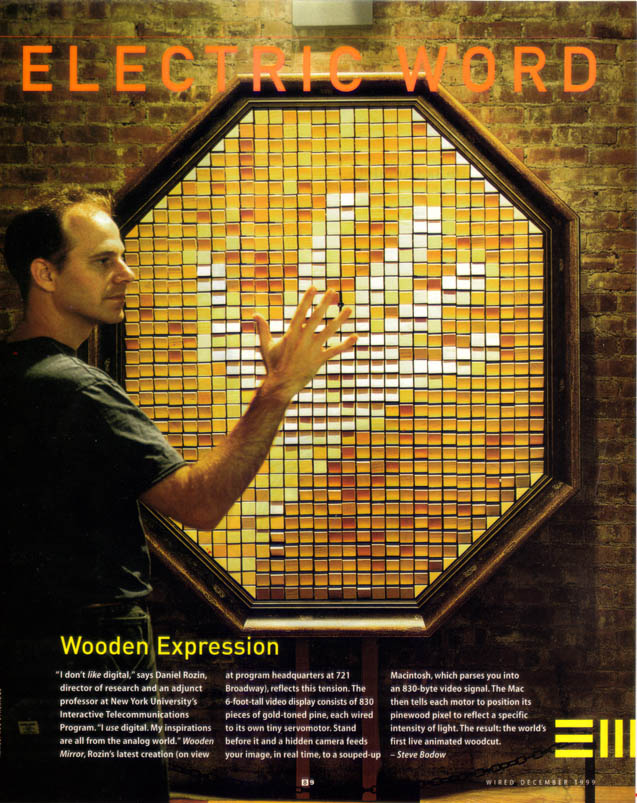
When I went to the Children’s Museum of Pittsburgh last week, I saw a version of the wooden mirror by Daniel Rozin and was blown away by how artist engages the viewers. It’s just like standing in front of a mirror, but the mechanism behind it is so unique that you can’t help but keep playing in front of it and listening to the wooden sounds. Basically, when a viewer stands in front of one, his/her image is recorded by a camera, which is then sent to a computer. The computer directs motors to rotate each wooden square to appear darker or lighter depending on the shade of its corresponding pixel. I really think Rozin nailed the purpose of interactive art in the way the viewers become integrated into the piece itself.

Also, Rozin has mechanical mirrors made from other non-reflective materials like rust, trash, or pegs. I think his projects really blur the line between natural media and digital concepts. I can also imagine this project on much larger scales to convey the prevalence of pixels in our world nowadays.

Here is a link to his website: Daniel Rozin – Interactive Artist
And here is a video on Youtube:

Technological Art that Inspired Me

As someone who is fascinated by weird, abstract concepts such as the 4th dimension, I was immediately drawn in by the ‘Hypercube’ installation by Jaap van den Elzen. Collaborating with sound designer Augusto Meijer, Jaap van den Elzen created a surreal and disorienting experience that gives the viewer the illusion that they are trapped in infinite space – despite being in an enclosed box that is only 2 meters wide and 2 meters tall. Within the cube, the viewer is surrounded by loud, discordant ambient noise and color-changing neon lights that seem to stretch on for eternity. By shutting the viewer out from reality and immersing them into an area in which their senses are invaded, this audiovisual project provides a new way for people to experience space.

An article overviewing the project by Mitja Prelovsek

Welcome to EMS2!

Dear students! Welcome to our section of EMS2, “Introduction to the Electronic Media Studio” for the fall semester of 2013! This course is an introduction to the core tools and idioms of interactive and computational new-media arts. Usually we cover topics like interactive imaging (with Processing), physical computing and microcontroller programming (with Arduino), and flow-based signal patching (with Max/MSP). Our core goal is to produce stimulating and provocative new culture.