Charlotte-LookingOutwards-1

Something I admire

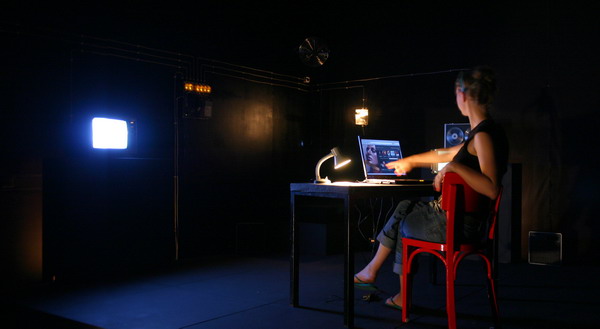
Poweronoff by Danja Vasiliev is a representation of the business a web surfer creates by just loading ads on their computer. The participant is placed in a room that has all the appliances that are part of a meager life, but none of them have power, only a laptop running on battery power. The participant’s only option is to load ad banners on the laptop, and then the amount of revenue crated by loading the banners is converted to watts and used to power this person’s life.
panoramic

It helped me grasp the value the came from simply looking at an ad banner, by measuring the value in watts. The application of the monetary funds from ads as your lifeline was really creative and gave the project a futuristic and dystopian feel to it. Next time this project is made is should incorporate how your interests are sold to ad companies so they can show you ads your more likely to click on, maybe the longer you surfed, the more valuable the ad banners became. Also I wished the artist wrote a bit more on how he came up with the ad prices.  This is part of the movement of activists, artists and hackers (like LulzSec) who want to remind their audience of how big corporations are a part of our everyday life without us thinking about it or questioning it.


Something that surprised me

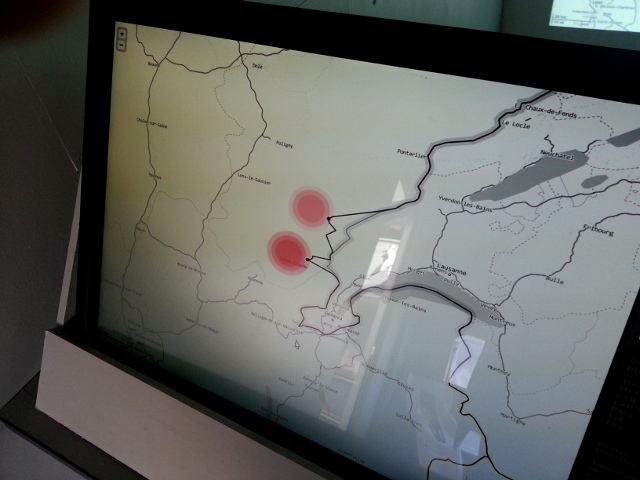
Boarder Bumping by Julian Oliver surprised me. Oliver noticed that cellphone networks do not obey territory borders; He created a smartphone application to collect the data of cell phone boarders, and put the information together in a map.
6-sml

At first I was disappointed in this project because I thought this was something that should only concern the carrier companies. That’s not the case; really it is challenging the integrity of national borders. (This is also related to another awesome project by Chris Pinchen about how cellphone towers are disguised as something like a tree or a wall)


Something that could have been done better

‘i am swimming in a pool’ by Gordan Savičić is a reinterpretation of alvin lucier’s well-known audio masterpiece ‘i am sitting in a room’, A submerged hydrophone is used to pick up audio waves the come from people swimming in this pool. The people swimming in the pool are wearing waterproof headphones that are streaming the sound of the bottom of the pool.

swimming00

This project disappointed me because it seems like something very complicated and expensive to set up, when the user experience wouldn’t be extremely fulfilling. Judging from the photo of the project being preformed, people were just dunking their heads in the water for a quick listen with only one person getting the full experience.

swimming02

This project was by Gordan Savičić who usually has a really interesting and original point to his projects.


Critical Engineering 4

Tenet number 4 urges the critical engineer to not only look at how one creates a work, but more importantly how the work changes the world around. What is interesting about this tenet is that it implores the critical engineer to understand that the work is not something that exists in a realm all its own, but shares space in a whole world of other works and people. As such, works created by the engineer are more significantly considered in what they do, rather than how they are built. Like the Machiavellian way of thinking, critical engineers must be equally if not more concerned with the ends of a work, rather than the means.

I know of no better example to this tenet than the plot of Jurassic Park (1993 film). The genetic engineers were brilliant at their craft, having resurrected creatures dead for over 65 million years, but they failed to consider the implications of doing so. One simply does not know how creatures from such a radically different environment would react to being brought into a modern world, and the result was ultimately disaster. As Ian Malcolm (played by Jeff Goldblum) put it, “Your scientists were so worried about whether they could, they didn’t stop to think whether they should.”

User Engineering – Critical Engineering 5

The Critical Engineer recognises that each work of engineering engineers its user, proportional to that user’s dependency upon it.

This tenant states that a user of a technology will be changed based on the technology and the user’s dependency upon it. A prime example of this which is prevalent in today’s society is the use of smart phones. Smart phones have given users easy access to data such as social feeds and email in their pocket. Without them, I believe that the users who are so focused and consumed by their social feeds would not be at all the same. In this way, smart phones have engineered the society to be more dependent upon social media.

Written by Comments Off on User Engineering – Critical Engineering 5 Posted in Assignment-01C

The Infinite Jukebox

During a long study session sophomore year, my group listened to music in an infinite loop. I mentioned that it was upsetting that the amount of time that passed could be too easily realized each time the end of the song came. A fellow student showed me the infinite jukebox. It takes a song and plays it forever by finding similar spots within the song and randomly jumping back and forth. I was amazed that a song could be stitched together so seamlessly by a computer because I had previously done a bit of work trying to stitch songs together and found it to be a hard task.

It would be interesting to see this platform expanded to take several songs and play them together or mix songs over each other.

This project was made by Paul Lamere during the Music Hack Day Boston on November 11, 2012. It can be found at http://labs.echonest.com/Uploader/index.html.


Birch Cooper and Brenna Murphy aka MSHR — Ritual Interfaces and Psychedelic Kitsch

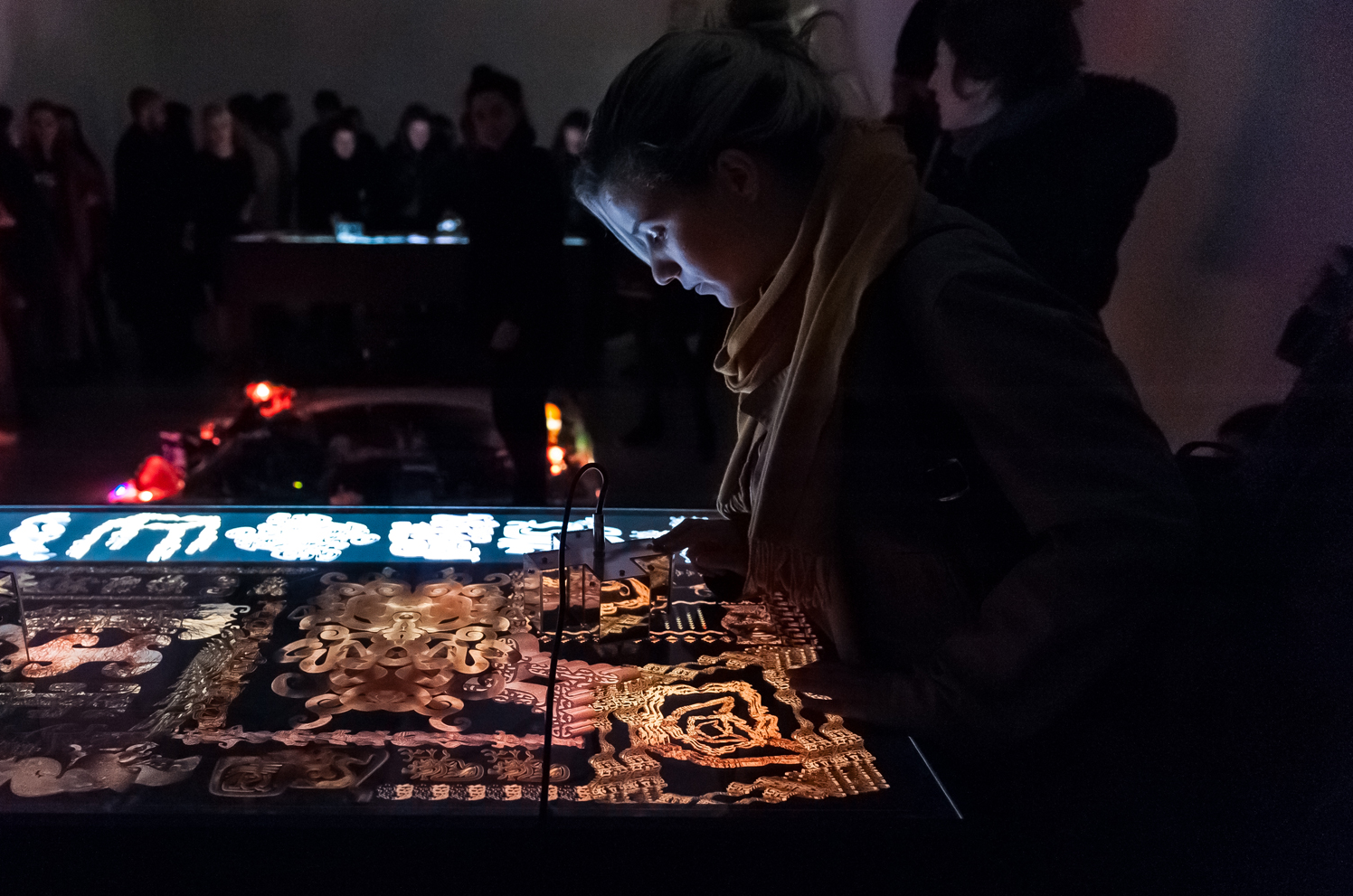
February 27th in London, I saw a performance and installation at Cell Projects by MSHR, a project developed by Birch Cooper and Brenna Murphy. In the dark rectangular room were two long, matching tables on either end of the room, each illuminated by an array of complex, multi-layered decals just below their surfaces. Like the way plateaus of cloud pass over one another in the sky, the appearance of these shapes were defined by the varying opacities of their smaller overlapping geometric components. Both psychedelic and organic in form, but equally referential of the aesthetics of circuit boards, unintentionally silly visualizations of proteins, and the fractal structure of organisms and natural phenomena. In the center of the floor between the two tables was a kitschy arrangement of custom-made synths, conch shells, lightbulbs, and these bio-techy metal decals depicting linearized dendritic structures.

The artists began to play with their synths — noises, using various participatory mechanisms to modulate the cacophony that was slowly building. For instance, in the center of the room between the two artists  on the floor, two people would stand facing one another on mats sensitive to the movements of their body and loci of touches between them. So I watched as couples rubbed one another up and down and poked, prodded, knealed, and so on, and listened to the music change. Reminiscent of David Rokeby’s foundational 1986-1990 work “Very Nervous System,” in which his differential [and admittedly funky] movements through xyz space were recorded through video camera[s?] and translated into respective changes in the pitch and speed of the soundtrack he danced to. Rather however, the self-described “ritualistic,” and what I think of as the ‘earnest kitsch’ of MSHR’s interface conscious installation seems to point to an ambiguous, yet charged, humorous, and non-cynical stance towards the techno-optimism of the 90’s  new media work it is derivative of.


MSHR ~ TerrestrialSenser from MSHR on Vimeo.

JohnChoi-LookingOutwards-1

One project that I admire profoundly

Compressorhead is basically a 3-man, er, robot rock band that plays contemporary music in ways impossible with human instrumentalists. This group brings new meaning to the term heavy metal, as the machine team is literally built of heavy metals with wires, actuators and computers. Compressorhead proves, or rather, disproves, the notion that truly great music, or art in general, must be produced with the direct hand of human beings. These robots do things humans simply cannot in their present form – clashing drums with four arms, strumming guitars with 40 fingers, or even playing exactly the same way every time. The idea that derivative works can create further derivative works in a way that challenges the inherent limitations of the creator opens whole new world of possibility, and this, is why I find this piece profoundly inspiring.

Built by RoboCross Machines, Germany.

One project that surprised me

OMOTE is a rather odd project, to say the least. In essence, it demonstrates one use of real-time face tracking technology coupled with projection mapping onto the face being tracked. The result: an artificial visage attempting to subvert its living host face into expressing its own image. The projection displays and warps the host’s face into robots, slime, reflective metal, cubist fracturing, and other human faces. The real-time renderings are uncanny to say the least, especially since it deals with the subject of human faces – one wrong twitch, one odd wrinkle at the wrong place, and the whole thing becomes abominable to look at. This is not what surprises me though – what surprises me is rather the relationship between the user and the projector. The user can never really know what her face looks like as his or her eyes are shut. Ultimately, the user whose face is being tracked is subject to whim of the artist controlling the projector.

Created by Hiroto Kuwahara and Paul Lacroix, 2014. Additional help by Nobumichi Asai, Jin Hasegawa, and Takashi Ishibashi.

One project that could have been great but disappointed me

Out of Control by Visual System is great. It certainly is an impressive monolith of light and metal, and as described by its creators, this piece depicts the awesome fury of the “Super Machines” that are to come in the near future. However, for me, it does not quite hit the mark. This project presents a flashy light-show that tells the story a “Super Machine” fighting to survive against a virus threatening to corrupt the machine to oblivion. The primary reason I do not see this piece as great is because it both incorrectly portrays what the plight of a supercomputer against a virus would look like, and the fact I do not think it does enough to show what a supercomputer would do in order to fight against such a virus. I understand I may be somewhat shortsighted or naive here, especially since this video shows only a teaser of a digital art installation, not a supercomputer fighting a virus. Even so, perhaps the real reason I do not think this piece is great is because I fail to see how, without the description provided by the artist, one is supposed to deduce that this gigantic light-show is representative of a futuristic “Super Machine” battling a virus.

Created by Team Visual System, 2014.

Technological, Artistic, and Inspirational

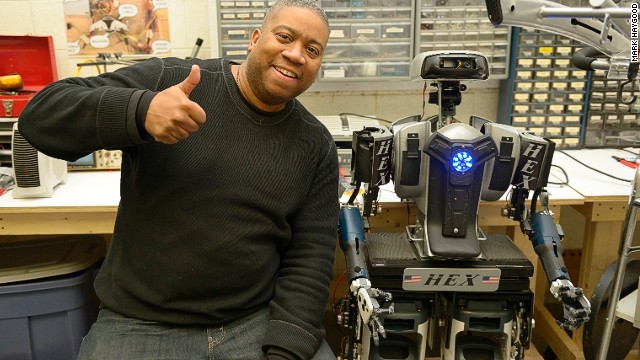
I deeply respect HEX, a four-foot humanoid robot advanced enough to show itself as a modern marvel. Why do I consider HEX to be so special, especially when there are so many other large, more advanced humanoid robots currently in development, such as ASIMO by Honda? The answer is not in the technology used, but rather who built it. HEX was built by one man, Mark Haygood, a retired police officer from Baltimore. See, Mark had no experience in robotics, but he had grit – he learned how to do it through countless hours of research, trial and error, and raw determination. Spending over four years and tens of thousands of his own funds, he finally brought his imagination to life. HEX, when directly compared to robots like ASIMO, falls short in just about every technological aspect, but shines in another: HEX stands as a testament to the human spirit and proves to the world what just one person can do.

HaygoodHEX

By Mark Haygood, 2013. Reported by Matthew Knight, CNN on May 10, 2013.  Link:  http://edition.cnn.com/2013/05/09/tech/innovation/robot-humanoid-baltimore-robocop

GHC/FWLW

It’s possible to draw certain comparisons between the Garter Hype Cycle and the First Word/Last Word Models. One could say that the First Word appears at the Innovation Trigger, and the Last Word can only come to be once the Plateau has been reached. However, the Hype Cycle applies specifically to disciplines, while FW/LW can apply to much more compact things, like ideas or techniques. there no space on the Hype Cycle for Hunter S Thompson, but he fulfils both halves of FW/LW in the field of Gonzo Journalism.

Personally, I feel drawn to the spaces after the initial hype of an idea has died, because then there remains a living progressive dialogue, which I find more interesting and useful. There is also none of the Hype’s manic speed here.

Schulze himself notes that working in the Trough of Disillusionment is a good choice financially, since the technology has already been developed and over-produced. He just needs to figure out what to do with it. However, there is also a certain romantic draw to this space, this graveyard of concepts where somebody could resurrect an idea and make it into something truly great.

Critical Engineering 1

Tenent 1 of the Critical Engineering states that the Critical Engineer must constantly consider the tools that they use, and the dangers associated with these tools. They must constantly test and expose the functioning of these tools, so that they may be both trusted and improved.

I find this tenant compelling because it demands constant vigilance towards tools, which we often blindly trust despite their essential role in human progress. This is especially true in today’s digital world, where a weakness in a piece of code can be found and abused  from anywhere on earth.

Tech Art Inspiration

Quadratura is a site-specific installation that is video projection on architecture made in 2010 by Pablo Valbuena. I admire this project because of its minimalism and how Valbuena has framed this installation, he made a story behind it and made it more meaningful than it is just on the surface. The name “Quadrarura” is related to walls that have been painted in architecture, to manipulate the space it is on, just with material not related to physical world. It is not a breakthrough or any new technology, but its really good at making something old (projection mapping) and turning it into something that intrigued me.

He used a virtual version of his site to map out the projection of light.