Category Archives: looking-outwards

Bryce Summers

14 Jan 2015

I found a neat popup book entitled ABC3D, invented by Marion Bataille.

This project is a Popup book with a lenticular cover that conveys each letter of the alphabet through a dynamic, interactive reading experience. The letters are implemented as popup shapes that require many different movements to view properly.

When I started exploring digital art (broadly construed), I communed with many fascinating structures that I had never seen in the real world. I witnessed fields of perfect sinusoidal fields, utilitarian user interfaces, and other peculiar visual forms that many people had independently discovered, and visualized. I believed these visual artifacts to be products of the virtual world and completely separate from the Physical world that the average person eats, sleeps, and breaths in.

As time has passed, I have noticed that it is possible to naturally encounter many visual effects that seem to be unique to the digital world in the real world, for instance I was sitting at the dinner table at my parents house one day and looked out a screened window and noticed that the screen actually pixelated my view of the outside world! I currently believe that visual effects of digital culture should also be present when encountering designed culture, i.e. buildings, chairs, side walks, and everything else that humans have made. It makes sense that there might be an equivalence relation between the two because both of these fields of work were created by humans.

This project tickles my fancy, because it demonstrates properties of font geometric decomposition, interactivity, movement, and experimental structure that I have previously only seen in Electronic art and typography. The project also uses connective pieces, reflectivity, and translucence in ways that appeal to the pattern and form lover in me.

As for a critique, I will say that the color scheme could have been more varied and it seemed as if some of the letters repeated themselves. I think the author nailed the creative task of finding relationships between subsequent letters and did quite well at working within the ordering constraint. The history of pop-up books is pretty well documented, due to it being a very well known medium. The designer’s website is: http://www.marionbataille.com/ She has made several artistic books based on forms.


Second Project

http://www.csismn.com/SYN-Phon


This project, based on the art and composition of Candaş Şişman displays a lengthy graphical display that conveys subject matter through time. As the imagery scrolls performers produce tones to match the imagery. I like this project because it conveys a story through structured imagery along with a relationship between musical sound and imagery. I think that the documentation provided makes it a bit unclear how improvisational the performance was, but I feel as if the music could have been a bit more consonant. It would be interesting to make the reverse project, that in which musicians perform and a computer generates structured platforms that represent the performance. Then a 2D platform based game could be formed with a unique procedural creation technique. One potential influence is the capturing of local sounds as a representation of culture. I have seen several pieces including one at the Frame Gallery that have used locally captured sounds to make the artwork more intimate to its intended audience.

dantasse

14 Jan 2015

I’m kind of sad this is for new things only, so I can’t post about re-finding Black MIDI.

But here’s something close. Specimen Box, by the Office for Creative Research, is a visualization/sonification for botnets. Data comes from Microsoft’s Digital Crimes Unit.

Specimen Box – Sonification from The OCR on Vimeo.

It has 3 views: 1. see all botnets animated as messages come in, 2. see one or two botnets alone as “retina plots” and listen to their activity (video above), 3. plot botnets along 3 axes. It’s oddly soothing to listen to them. I think the unlikely but awesome outcome of this would be that people can listen to it and hear patterns in the botnets that help them fight them. Less awesome but more likely: makes botnets more approachable, both raising awareness of an issue while lessening fear. It’s kind of hard to be scared of one of these things playing a soothing noise.

I’d like to know, well, if it works. If it’s useful; if it helps people to find out more things about botnets, or if it’s just pretty. Not that there’s anything wrong with that.

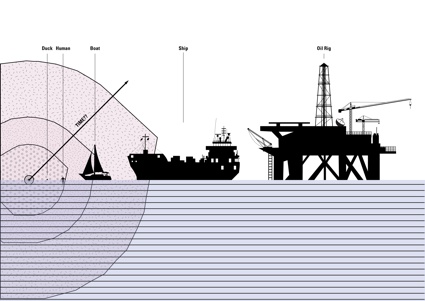
Fatberg (warning: kind of gross), on the other hand, is somewhat more organic. It’s a giant mountain of fat. They aim to build it in the ocean and get it to the size of an oil rig. I think it’s cool to take something so common and unseen, and make it definitely seen. I know it’s not really their goal, but I’d think that it would be pretty effective in preventing future sewer clogs, if enough people saw it. Plus, it could be a neat piece against the factory farming system and crazy quality of meat we eat, if they wanted. But it’s not.


They insist it’s “not a speculative design project”, but rather “inspirational data” to stimulate the imagination. I don’t know, that sounds like a speculative design project to me. It’s almost too flippant, like a stunt more than something to actually make you think about anything in particular. Still, I appreciate the scale, and the willing to deal with the squeamish.

alexsciuto-lookingoutwards-1

The Dawn Wall: El Capitan’s Most Unwelcoming Route

Screen Shot 2015-01-14 at 2.57.07 PM

http://www.nytimes.com/interactive/2015/01/09/sports/the-dawn-wall-el-capitan.html

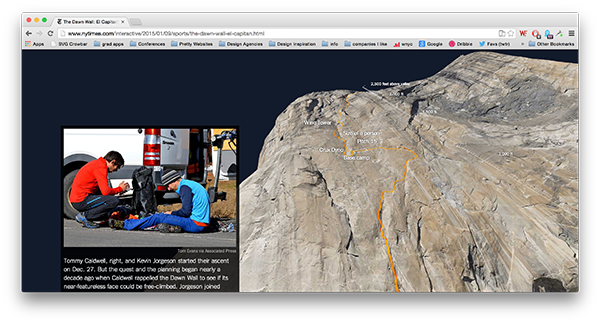
This was a news project I saw this morning, and I think it’s a great use of web-based 3d. The New York Times article shows a series of images and captions as a 3d model of El Capitan is rotated in the background. The 3d movement give the viewer a better sense of how large the cliff is, and the added labels and scales give me more cognitive information about the wall itself. When I first opened the page, I scrolled up and down it a few times, mesmerized by the 3d models smooth movements. The experience has stuck with me all day because the creators got the most important part right: that by having a moving model, the viewer would get a better sense of how big the wall is.

The creators of the project could have done more with the 3d model to convey its massive size. In the first swoop of the model, we are meant to see the cliff from its base. But the movement felt more like the cliff was being laid flat on the ground. That movement suggested to me showing comparable other objects next to the cliff. How many football fields tall is the Dawn Wall? How many city blocks?

I can tell that the project was created using WebGl and D3.js. D3.js’s creator, Mike Bostocks comes out of Stanford and Jeffrey Heer’s data visualization lab. I haven’t seen many good uses of WebGl to date. I remember http://spacecraftforall.com/ that used WebGl and 3d in conjuction with documentary footage and interviews iISEE-3 reboot. Google Maps uses WebGl for their maps (try Google Maps, go into satellite mode, and zoom out as far as possible). On the non-technology side, this graphic seems to fit in with National Geographic’s great history of creating detailed maps for print that included lots of overlays of additional information. like Draining California and this map of Venice.

Echos

Videographer Susie Sie creates rich and mysterious textures using common materials filmed in slow motion. In Echoes, she uses video of inky fluids to create other worldly effects. The music and sound design is by Clemens Haas.

I like this piece because of its raw experimentation and craftwork that ends up as great polish. Sie didn’t do any advanced computer editing, she took great films shots first. Together, the shots and the music induce a feeling in the viewer that is both sinister and also beautiful. The unknown in majestic and kind-of-scary glory.

Sie describes her work as trying to expose the underlying mathematical-basis for nature using strictly analogue means:

She is on a mission to explore the physical and mathematical nature of unusual forms, substances and materials 
to show the hidden beauty and magic of our natural world that constantly surrounds us.

Her dedication to analog and documenting nature as specifically as possible reminds me of Group f/64 from last century. Like Group f/64, Sie is dedicated to using photography without much human intervention. For the camera to be a seeing eye that impartially takes in the world that surrounds it. Unlike Group f/64, she seems to realize that the act of taking a picture is by itself an editorial choice. We can never really objectively photograph the world around us, just as can never write about or draw the world around us.

I call this piece an experimentation because it can’t live on its own. There’s not enough there to sustain interest or engage for more than a few minutes. I think the web video format doesn’t suit the piece. What if it were in a different context? One that allowed people to ignore or pay attention to it as they liked? What if we were given more information about what is being filmed? I think these images could be used in other projects very well.


John Choi

14 Jan 2015

QUMA, by SoftEther, Japan. 2011.

Basically, this is a device sold by a small company in Japan that allows for easy posing of humanoid figures in 3D applications.  In essence, it is a mannequin that plugs directly into your computer and sends data on the angles of every joint.  This project inspires me because I want to build one!  About the posability aspect, one the back is somewhat of a limitation (It appears to wearing some kind of “backpack”).  I’m not sure how well other humanoids with different proportions would work, but I guess that is something we’ll have to see.  Critically, though, this is just the beginning of something cooler.  Although this fits the bill exactly as they described on their product page, I think this needs some really cool interactive software to go with it.  A video game console isn’t anything without the video game.  Perhaps something like controlling giant virtual robots in real time, just like in Pacific Rim?

Input Puppets, by Interactive Geometry Lab at ETH Zurich. 2014.

This project is very similar to the other project I found above, save for one small difference:  with this experimental device, you can create whatever jointed posable figure you wish!  The pieces are modular, meaning that posable figures are not limited to humanoids.  We can pose elephants, dragons, snakes, and even octopi.  This thing has potential to be used in a variety of cool applications, and what we’re seeing in the video is just scratches the surface.  To improve this project, it needs some awesome software to go along with it. How about building a giant virtual robot and THEN controlling it?  Seriously though, the joints have no customizable limitations, save for the blockages at +/- 90 degrees.  This is a good thing and a bad thing.  While it allows more freedom, if used improperly, some pretty weird animations can result.

mmontenegro

14 Jan 2015

I was doing some research for my ETC semester project which involves a motion capture when i came across the two projects I am going to discus.

Map Visibility Estimation For Marge-Scale Dynamic 3D Reconstruction:

This project is tracking movement and then generating the movement path of the objects dynamically. Markers are attached to the objects that what to be tracked so the motion capture cameras can see them and human joints are tracked automatically similar to how the Microsoft Kinect does it. It is a research project here at CMU with its main focus on creating more accurate motion detection by optimal camera detection. In other words, selecting the right cameras for each point (in a very small nutshell).  It was done byHanbyul Joo, Hyun Soo Park, and Yaser Sheikh. I founded this project very inspiring because all the raw data of movement creates beautiful color patterns and shapes and because it solved almost all the issues the Kinect has to encounter when tracking humans. I feel that a very cool installation could be created with this type of technology because the entire human body is being tracked in a 3D cube/space. this would allow for a completely immersive tracking experience!

After finding this project, i decided to try to see what else similar to this is out there and I found this:

NuFormer – Virtual Reality-Video Projection:

This project is trying to combine virtual reality with motion capture to fully engage the user in the experience. apart from this, it generates a projection of the user in the virtual space to show to the audience what he/she is seeing and experiencing. This type of experiences are being explored to look for more possibilities of how far we can push VR and full our brain. This one was made by NuFormer. I really liked the concept of combining virtual reality with motion capture, this is probably what we are going to end up doing in my ETC project, but I feel this project was just a proof of concept. I didn’t find the experience that engaging, yes the art is nice, but with so that power, something more creative would have been better. Something that would really make the user be in the edge!