Category Archives: looking-outwards

mmontenegro

25 Feb 2015

Soccer Game


As I was looking for nodeJS examples to get some inspiration for my bot I came across this amazing nodeJS soccer game. I thought it was a very nice way of using simple shapes and gestures to play a multiplayer game online. I also liked that it is all online in javascript and html. it makes it more assessable to other and I think inter actives are going to start moving all towards the web given that it is growing in strength! Here is the well documented blog the creator Gabriel did: https://gabrielmfadt.wordpress.com/tag/soccer/

SPHERE: videomapping installation


For my final project I am thinking on doing something in relation with projection mapping. I have always water to and I am thinking on taking this opportunity to finally do it. With this in mind I found this mind blowing experience. I love the idea of using a real object in the canvas as part of the story the projection mapping is telling. It makes it look SOO real!!! I really got inspired by using real objects in the scene to create something. How the light interacts with the object is different, more crisp, i just loved it!

Zack Aman

23 Feb 2015

One of the ideas I’m interested in pursuing for my final project is bot vs. bot entertainment.  I built an IRC bot to scrape Twitch chat (for the data scraping assignment) and am able to write back to the chat as well, but my friend had an idea that I thought was brilliant. In his words, “The real coup de grace is if they were chatting about bots playing each other.” Turns out this is definitely doable, and I’d like to have a Twitch stream that streams 5v5 bot DotA matches, with bots commenting asinine things as spectators.


2048 AI Solver

2048 AI Solver

This isn’t an art piece, per se, but I thought it would be interesting to look at it from an entertainment point of view.  The 2048 AI Solver is exactly what it sounds like: a playable version of 2048 that also includes an AI to either provide a hint or to run automatically until it gets to 2048.

I’ll admit it: I never beat 2048. I was always too lazy to consider my moves and tried to “feel out” my swipes in a half-random fashion. Watching the computer play with a decided strategy was enlightening and mesmerizing. I don’t think it’s repeatedly entertaining, but there’s a certain beauty to watching the computer solve a problem that I never was able to grasp.

For what it is, it’s completely perfect. For what it’s not (an art project), it is lacking. What I would enjoy seeing is a head to head competition of two separate AI’s, perhaps presenting the code or algorithm behind each one and asking the observer to guess which one will solve the puzzle faster.


Chess Bot WhiteChess Bot Black

@ChessBotWhite

@ChessBotWhite and @ChessBotBlack are two twitter bots by Aaron Marriner that play chess against each other.  It looks like each bot makes a move roughly every other hour, posting the algebraic notation for the move and the resulting board to twitter.

I love the idea of bots playing against each other. Game AI is often seen as a thing to practice against so that we can avoid embarrassing ourselves when we play against other humans. In chess, however, AI has long since surpassed human capabilities; shouldn’t this imply that two bots playing against each other will be a high level game worth spectating?

In this case, no, we cannot infer that the game is at a high level as we don’t have a point of reference to human ability.  That’s alright though, since what actually might be more interesting are the places where the bot goes off the rails and makes a mistake. Called out mistakes would give a sense of drama. I’d also like to see a running tally of which bot is up more games, or anything to make it feel a little less automatic and a little more human.

This project likely has its roots outside of the art world, going back to IBM’s Deep Blue, though chess AI has worked its way deeply into chess culture. A related work is @PlayLightsOut, another game playing twitter bot, albeit one that plays in response to human tweets rather than  against another AI.


Alex Sciuto

22 Feb 2015

These two projects are from an exploration of projects related to visualizing text corpuses. I’m thinking that my final project will be a dataviz project for exploring State of Union speeches. These two projects are also from Lynn Cherny’s TextVis Pinterest Board.

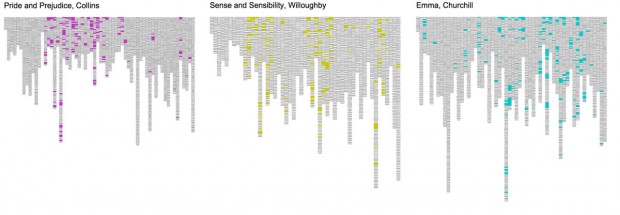
Visualizing Jane Austen

words

This is a chart of visualizing where words appear in different Jane Austen novels. I like the wide overview they give of the entire novel, and I like how the different words, when chosen correctly, tell the viewer something interesting about the structure of the book. I think the project could be improved a lot. This is the start of a great visualization, but it needs more layers of interaction and data to make the experience richer. My first thought it to let the viewer zoom into different paragraphs to see each block, but I think rearranging the text blocks according to different properties would be enlightening too.

Understanding Shakespeare

shakespeare

I want to highlight this project because of its gorgeous print design. It’s an undergraduate thesis visualizing the hidden connections in Shakespeare. From the project website:

As a result, and based on data from the WordHoard project of the Northwestern University, an application of computational tools was explored in order to extract and visualize the information found within the text and to reveal its underlying narrative algorithm. The five approaches presented here are the first step towards a dicussion of this potentionally new form of reading in an attempt to regain interest in the literary and cultural heritage of Shakespeare’s works among a general audience.

The project is doing interesting transformations of text, then delivering it as a book. I like the return to printed form that hints at a reimagining of what reading could be if infoviz were inserted into books. The designer also made a series of interactive processing applications. I wish I could have seen those.

Bryce Summers

20 Feb 2015

Introduction

While reading a stack overflow answer a couple of weeks ago, I came across a question that was asking about some particulars of the operation of elevators.

http://ux.stackexchange.com/questions/71855/why-do-elevator-doors-close

This post inspired me to start designing a computer game about elevators. I am planning on creating a computer game about operating elevators in a busy corporation with the goal of helping the corporation remain as productive as possible. I would like to place a special emphasis on practicing my design skills, particularly making the gameplay and user interface fun and user friendly.

Since this a looking outwards dedicated to capstone research, I have decided to share 2 examples of projects related to my planned one in some way shape or form.

 Elevator Saga

ElevatorSaga Web Interface

ElevatorSaga Web Interface

http://play.elevatorsaga.com/

Elevator Saga is a game for people like me. It is a game where you design an algorithm for operating an elevator to service a set of floors and people. The player designs the algorithm by writing code. While this game is not necessarily accessible and fun to those who do not know how to program or those who aren’t passionate about online algorithms and data structures, for the small set of people such as myself that enjoy this sort of thing, this game embodies the beauty of the logic needed to design a modern elevator system. This game embodies the fundamental reasons that cause me to be very excited about elevators. To make this game more fun, it would have to do away with the programmatic game play and allow the user to guide the state of the game through visual interactive input.

 Standard Internet Elevator Games

Representative Internet Elevator Game

Representative Internet Elevator Game

http://www.agame.com/game/elevator-rush

Over the years, I come across internet games based on elevators. Most of them involve 1 elevator that the player moves up and down to let people off and let people on. They all relate to the concept of providing a transportation service to passengers, but they usually differ in small game mechanical ways. These games will probably be very good places to look for gameplay ideas and prior game mechanical work. For the example game that I have listed here, it is on the opposite end of the spectrum of my gaming interest. Whereas the first example is completely syntactical and controlled, this one looks like it is too much on the “fun” side and is perhaps a bit too fluffy. I would like to find a way to synthesize the algorithmic intrigue of defining an elevator procedure with elements that can make the game appealing to a wider range of people.


amwatson

19 Feb 2015

Selective Memory Theatre is an installation that addresses the interaction between memory and perception.  It retrieves collections of Flickr images in and, in real time, distorts and decays an image until a “similar” image is retrieved and associated with the earlier “memory”.  Two screens, the “perception layer” and the “memory layer” depict the interaction between the senses and memory.

This project stood out to me, because I’m really interested in theatre that tries to depict the mind and explore the mechanics of perception, and it’s very cool to see someone using tech and real-time computation to create visualizations for the stage.  I think it defeats the purpose of “real-time” a bit to rely on manual tags to denote similarity rather than actually determining it computationally (otherwise, the machine really isn’t acting as a brain, it’s just sort of pretending to).  I’d like to see something like this, but with some clever processing to detect similar features in the existing dataset.

The artist explains that he was inspired by the “permanence” of digital memory, and that he wanted to instead model a more human notion of impermanent memory.  I’m reminded a lot of the Entropy programming language, which attacked the permanent nature of digital memory by permuting data every time it was touched.  The artist also has previous real-time visualizations he calls theatre.

Ethical Thinking is a set of “smart” devices (such as the fan displayed) that are intended to be directed by ethics, rather than user instruction.  Its settings guide what moral code it uses and, when determining how it should function, the device consults its memory, mathematics, and ultimately Mechanical Turk to determine what action is most ethical.

I really liked this project, because I think it explores a lot of really interesting questions about how to engineer differently, and the limitations of technology.  The way in which the project was built is as much, if not more, of an artistic exploration than the final output: as engineers, we are used to a couple base heuristics when we design.  Designing something with vastly different expectations and aims, something fundamentally more human, requires a unique and culturally significant departure from the way we traditionally think about machines.

With that in mind, I’d be interested in knowing more about what went into the design of the machine to make it “ethical”.  I want a better sense of why they chose their different sets of ethics, how an atheist should be expected to operate a fan differently from a hindu.  I’d also like to see the machine solve more interesting questions than the one the fan seems to.  Finally, I’m not convinced the fan in the video knows there are two bodies, where they are, and which one is fatter.  If not, I’d like to see it require less human interaction, and make decisions based on elements it can detect itself.

The project was inspired by the observation that machines so often operate under a programmed decision-making “logic” that is specific to a machine.  The engineers were interested in seeing what might happen if that logic was made more human — for instance, how would an atheist’s logic differ from a Hindu’s?  Like Selective Memory Theatre, the project identifies a certainty about how machines are made and attempts to negate it.