Category Archives: looking-outwards

Amy Friedman

15 Jan 2015

“Wanderers” by Neri OxmanChristoph Bader & Dominik Kolb (2014)

This project is a digitally grown wearable the can allow for living bacteria to live inside its chambers. The growth is based upon responses to their programmed environment based on biomass, water, air and light necessary for sustaining life. This project inspires me to think about conditions affecting the human body and how wearables can become more personalized if programmed to a specific environment and need. It gives power to the computer to grow organisms which can be 3d printed. Many have created duplicated patterning but this adds multivariants into the equation to allow for growth on its own to allow for life to grow.

The project could be more effective is you saw the inputs of how each example were changed, and a user interface was created to change the environments to understand how the living matter differs in other climates. How will it grow differently, how can we better understand what affects us as people, organisms, nature from this?

https://www.creativeapplications.net/objects/wanderers-digitally-grown-3d-printed-wearables-that-could-embed-living-matter/

http://magazine.good.is/articles/3d-printed-wearables-wanderers


“Armstrip” by Fitlinxx (2015)

This is a wearable body monitoring device that can be wore throughout the day, located on the ribe cage. This product using a heart rate monitor, and seems to allow for accurate understand of what activity you are doing throughout the day whether sleeping, working out, or working. We are seeing alot of wearables coming about now such as Sensoria, Fitbit, Jawbone all based upon sports performance. If Armstrip is accurate and provides a strong service design along with the product, it will differ from others as man have trouble differentiating between what type of activity is being done. The importance is that if the product isnt reliable we wont trust it to accomplish what we expect it to. Another critique is these are all methods to better understand out bodies but it doesnt mean we will from the data unless there is a critque of what we are doing and if our movements are correct. I appreciate that this is the first product Ive seen that focuses on letting you know if you have worked out too much to allow for the body to have a break. It inspires me to know more, and as how can we better ourselves through technology? What do people really want?

amwatson

15 Jan 2015

Daniel Tempkin – Entropy

“Entropy is about giving up control”

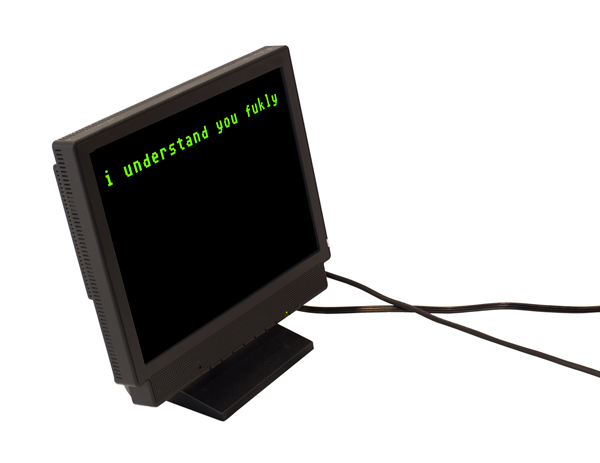
Entropy is a programming language in which program data is mutated every time it’s accessed.  Programming in Entropy is, by design, imprecise and unreliable.  It forces its programmers to abandon traditional assumptions — “the rigidity of logic” — and instead “compromise with the computer in order to get it to understand us”.

I love this project, because it doesn’t merely attempt to use technology as a novelty or a black box; instead, it examines the program for what it is and challenges some very software-specific notions to make an artistically rich statement about culture.  The experience is interactive, and forces users to, through the act of writing a program, encounter uncertainty where there typically is none and reflect on how their experience with the computer changes as a result.

While I think the idea and aims are great, it’s never been clear to me that Entropy actually does what it promises.  The sample program, Drunk Eliza, simply outputs increasingly mutated strings, but it’s never clear whether imprecision actually affects execution in any compelling way.  Either the project needs inspired programmers to craft more compelling examples, or the artist needs to find a better way to inspire programmers to write their software differently.

Miranda July – Somebody (2014)

Somebody is a mobile app for passing messages.  When a user wishes to send a message, it gets sent to the app user in closest physical proximity to the target, who delivers the message face-to-face.  It aims to create an experience that is “half-app, half-human”, and promises: “every conversation becomes a three-way”.

I love that this project makes such effective use of the app as its medium.  Somebody takes a tool we use constantly — the instant messaging application — and twists it in a way that truly requires engaging with others in a novel way.  I like that the artist has identified a medium that is so critical to the way we interact with others, and altered such that the experience really changes and requires new kinds of interaction.

While I like the concept for my own reasons, I’ve never managed to get behind the artist’s own justification for her work.  She calls it “the antithesis of utilitarian efficiency that tech promises”, and I think not only that tech is in no way utilitarian nor efficient by nature, but that this technology has far more interesting implications that simply making communication more difficult.


sejalpopat

15 Jan 2015

Automated Beacon
project site

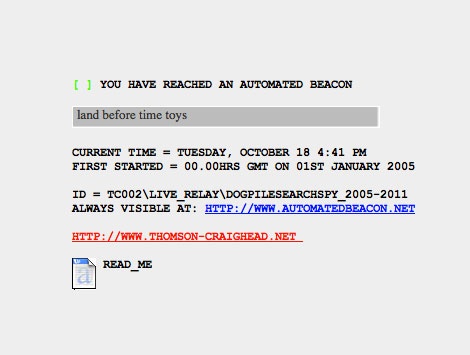
This project is a website that displays search queries it collects in real time. It “acts as a silent witness: a feedback loop providing a global snapshot of ourselves to ourselves in real-time”. When I think of searching for something online it seems like an extension of my curiosity/need to know more about a topic. It feels like a private event to enter a question or phrase and get results on it. Viewing it from this perspective makes Automated Beacon feel like peering into a global brain and its collective curiosities. The aesthetics are, if not outdated looking, bare and minimal to complement the kind of poetic premise. It also doesn’t provide much information beyond the search query itself which makes it a project you don’t necessarily spend more than a minute with. I’m not sure if it’s necessary or would ruin the mystery to try to add more, or slow down the display of different queries.

A Sense of Patterns
project site

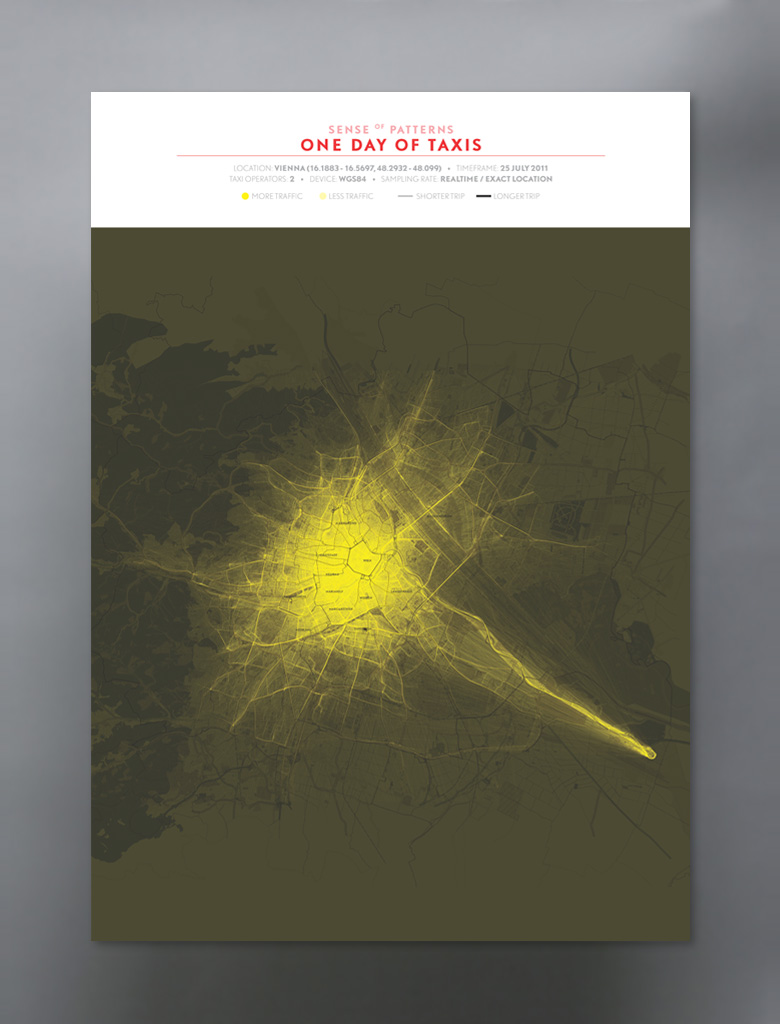
This project is an ongoing series of visualizations of movement through urban spaces. I found the initial description provided for this project really compelling: “The visualizations have a focus on the patterns of moving entities in public like commuters, cars and public transportation vehicles as well as the interaction between these entities and physical structures like roads, sidewalks, buildings and parks.” I’ve been fascinated by this idea of a city as a pulsing system of movement and energy and to see that visualized sounds very exciting. The static visualizations have an interesting aesthetic that seems to refer to neurons, webs or other biological imagery. But most of the data represented so far relates to taxi routes. I was expecting more novel visualizations different types of “entities” movements  so that we could see some of that interaction between physical structures, moving people and objects. While these are visualized by overlaying paths, I wish for example, that there was visualization of entities moving inside structures and out of them, some added dimension. This is one way it could differentiate itself from other mapping projects, given that mapping one’s path is becoming easier and easier to do as its integrated as a standard functionality in devices.


Matthew Kellogg-Looking Outwards-1

Foreign Nature

Julius Horsthuis created an immense and detailed fractal which he navigated and rendered for the Oculus Rift. I like this project because I like digital art that doesn’t borrow too much from reality, but instead creates its own. It is also interesting to see that a fractal can be so complex. This project makes me want to look into fractal art and algorithms. Also, I appreciate the lighting, material, and other environmental work put into the render. While the structure imposes impossibility, the render makes it feel more realistic.

Article: http://thecreatorsproject.vice.com/blog/now-you-can-explore-a-fully-3d-fractal-universe-with-oculus-rift


Specimen Box

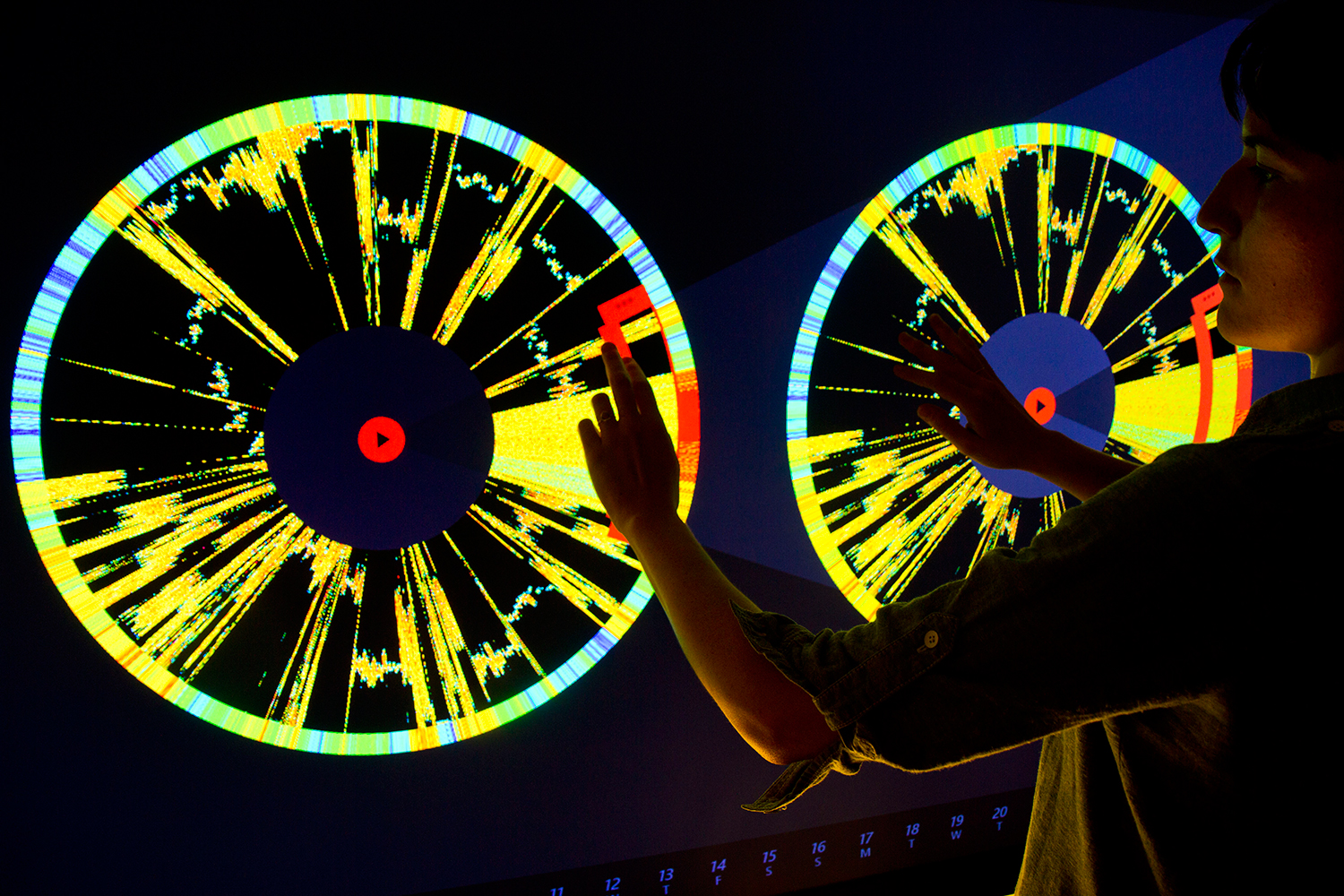
The Office for Createive Research created an interactive audio-visual piece that visualizes and sonifies the activity of botnets. I found botnets to be a great resource for data in an information visualization piece. I found the interface and interactions to be vibrant and smooth. I appreciate the color scheme, and all-in-all the interface seems very well designed. I do think however, that the sonification of the data to be useless. It sounds only like noise, because it has no audio basis, and the noise gives the user no indication or further understanding of the data. In my opinion, if the piece is to help understand in inform users about the data, this is clearly a mistake. Perhaps the data could be extrapolated in some interesting way to create something more informative/musical.

IMG_3027

LValley

15 Jan 2015

One of my first experiences with interactive media was when I was in kindergarten and I visited the Pittsburgh Children’s Museum. There was a display by the name of “Text Rain” by Camille Utterback in which you could stand beneath a shower of words.

If you held out your arms, the letters would stall on your limbs, and if you stood still long enough, you could even hold a sentence. The only catch was that none of it was real—the letters, the words, the sentences—they were all digital, but at the center of it all, I believed it was magic.

The interactive performance “Pixel” by Adrien M and Claire B instantly brought my back to my Children’s Museum days. In this piece, a series of performers dance and interact with a blackened stage filled with nothing but projected pixels. Apart, both elements would sustain interest for a little while, but together, a few colored dots and a woman with an umbrella create an entire storm.

Perhaps my favorite thing about Pixel is how seamless the actions appear. The concept of an interactive projection isn’t necessarily groundbreaking in this day and age, but framing it as a performance and having both the performers and the technology participate equally was something to evoke wonder in more than just children.


Pixel – extraits from Adrien M / Claire B on Vimeo.

After digging a little deeper, I was able to find another piece by Adrien M and Claire B that was a lot more similar to “Text Rain.”

The piece “XYZT” is a series of interactive experiences. Instead of just words, it features a technological, fun house-esque mirror, a letter Tetris game, and a tank of projected words interacting with real environments.

The diversity in this piece is one of the most striking elements for me. While the individual sections are similar, they each had a unique element that was enough to keep me interested throughout my discovery of each sub-piece.

XYZT présentation from Adrien M / Claire B on Vimeo.