Category Archives: looking-outwards

Zack Aman

28 Jan 2015


We Need Nothing to Collide from Mark Wheeler on Vimeo.

We Need Nothing to Collide is a music visualization synced up with Ableton and then projected with a 5000 lumen projector from a car onto the natural world.  I’ve always loved music visualizations — there are so many variables in music that the possibilities for visualization are endless, and breaking the visualization out of the screen and onto the natural landscape makes the work a breath of fresh air.  I think, however, that the visualization itself is a bit boring — there seems to be little variation in the forms.  More importantly, I don’t feel like I learn anything new about the music from the visualization, implying that the coupling between audio and visual is weak.


TANTRA is a mechanical and light based music visualization that drops ping pong balls onto a series of rotating paddles based on the note being played.  Similar to “We Need Nothing to Collide,” I love this concept for its ability to take music visualization outside of the screen.  The physicality to it is great, and the bouncing ping pong balls are especially playful.

I have the same criticism of this as I do of “We Need Nothing to Collide”: the link between music and visualization and movement is relatively shallow.  The clearest linkage is the relation between note played and ping pong ball dropped, but I’m not sure how the rotation of the paddles is supposed to figure into the equation.  It would be nice to see more variation in output based on variables in the music, but that would get complex pretty quickly considering the mechanical nature of the work.  The video documentation is edited a bit too frenetically for my taste, making it hard to actually get a long enough look at the machine for deeper interpretation.  Additionally, the beginning of the video made it seem that the sounds in the video would be coming from the mechanics itself, which was a awkward once it became obvious that the paddles were purely for bouncing and not at all for sound generation.

The same team that built the machine has done so previously, such as for Squarepusher.  I’m also reminded of the Chris Cunningham video for Aphex Twin’s “Monkey Drummer.”

dave

28 Jan 2015

This is more of a tech demo than art piece made in open frameworks. It demonstrates the possibilities of the technology, which is extremely vast and broad. However, the demo itself fails to show off anything spectacular. Specifically, what is being done on screen does not really require the specific hand motions, so it missed a great opportunity to dazzle us. It reminded me of FaceOSC, which reads in different inputs from the face.


The Echo Temple uses computer vision to let anyone interact with the music with a sign. The user moves a special sign around that modifies the volume, pitch and sound effect. I wonder what the piece would be like if all those are affected by the movement of the body rather than the movement of the signs though. How I wish I could experience it first hand though. It reminds me of rhythm games.

JohnMars—LookingOutwards—3

Simple Harmonic Motion from Memo Akten

Explained: A series of projects exploring the sonification mathematic principles, namely the sonic and visual interplay of pendulums with increasing wavelengths.

Chosen: I remember seeing this video a little while back (which Memo actually does cite on the project page), and thought it was awesome, so it’s kind of been in the back of my mind for a while now.

Critiqued: Although he has 9 different implementations in the series — each one an evolution of the one before — there’s not much difference between each one. There’s really only one thing to explore with the whole pendulum thing, and it was explored with #1; the next 8 explorations are redundant. I like the concept and execution of the entire thing, but not the stagnation. Also the artsy description of the meaning behind the work makes me gag.

Related: Again, see here.

Darkstar: Gold from from Sembler for Hyperdub Records

Explained: A music video for Darkstar’s Gold that uses 3D scans of the band members captured and visualized with OF.

Chosen: It’s a unique implementation of OF — a music video. What makes that notable, is that this is not an interactive work, it’s something that’s been highly edited and post-processed with After Effects and Cinema4D.

Critiqued: The band member’s faces creep me out a bit, but I guess that’s not sembler’s fault.

Related: The scans were created with Kyle Mcdonald’s Structured Light addon (which doesn’t seem to be available on ofxaddons.com.

Sembler also has a Processing port of the app embedded online, with the project source included.

The entire thing is actually kind of reminiscent of the House. M.D. opening title.

maddy

28 Jan 2015

ofxExiv2

ofxExiv2 allows you to read the exif data of jpegs and other fun image formats using the, predictably, exiv2 library. It is probably the bane of my existence. Why didn’t I find it until later? Why won’t it work? Why isn’t there an xcode project in the src? I want to fix it.

ofxNotifications

ofxNotifications lets you send, predictably, system notifications for OSX 10.8+ and Linux. This is chill af and I would like to send some notifications and piss off my users. I’m really searching for a tiny toolbar icon thing though. That’s my dream.

ofxStatusbar

oh! oh! there it is! a little tiny icon on my status bar! I am dead, and have arisen as a serene angel. This is everything I ever wanted, specifically, a little tiny icon on my status bar.

Alex Sciuto – Looking Outward – 3

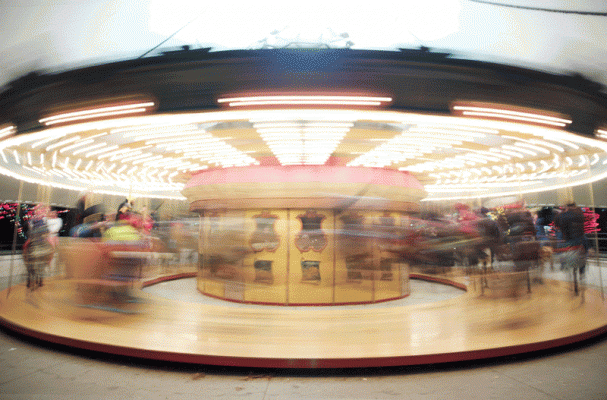
carousel-1

Carousel Gif

Here’s some inspiration for the GIF assignment. It’s a gif of a rotating carousel (there are others, but I don’t like them as much). The gif works well and is novel for a few reasons. First, its motion is takes of the full image and it loops. Not many real-life gifs do that. I like it on an artistic level because it uses the looping animation to tell me something new about a carousel. Different parts of the carousel move at different speeds. This gif falls into the category of cinemagraphs—gifs of photos with subtle animations. But I also think it connects back to the Lumiere Brothers, some of the first people to use cameras to capture motion. The Lumiere Brothers captured “boring” scenes of daily life that were made exciting through animation. In a similar way, this gif turns the prosaic into something more.

Fabulous Olfactometer – Sensorial prosthesis for air pollution

[iframe src=”//player.vimeo.com/video/102654799?color=ffffff&title=0&byline=0&portrait=0″ width=”600″ height=”338″ frameborder=”0″ webkitallowfullscreen mozallowfullscreen allowfullscreen”]

“Can we accelerate human evolution — by means of existing technologies — to cope with extreme living environments?” This project gives humans the ability to smell the chemicals in the air in an animal-like way. I really like the thesis of this project—that we can use technology to make us experience the actual non-digital world in a different way without resorting to screen-based interfaces. This is not a criticism of the project, but I wish this project would have been less grounded in art and decorative artifacts and proposed something more realistic that people could use. American capitalism is founded on the concept of “externalities,” of offloading your company’s costs—in pollution, in labor wages, in build quality—onto others, the environment, consumers, or workers. This project hints that we can experience these externalities in a more concrete way. I think there is a great need for these “enhanced experiences” beyond the realm of critical design / critical art.