I’m not sure what “capstone background research” means. I assume we’ll be having a big project at the end and we should start looking for some works that are related. I… gosh, I haven’t even thought about it yet. So I’ll do this one on “no particular theme”, and maybe do the next one on capstone background research.
Healthy LA by Rachel Binx – pure data viz, interactive, kind of fun to play with. Neighborhoods. I’m still into this, because it’s my main research focus, and here’s an example of a pretty, usable neighborhood visualization tool. But on the other hand, I’m not sure what I learned from it. I mean, health basically reflects income at this granularity, so I’m not sure if I’m getting anything else. Still, fun to play with, and I feel like I learned a bit about LA neighborhoods.
The Strange Log – github commit messages in video games -> tweets. A simple twitter bot, and I think it’s actually human-managed, but a great project all the same. Github commits are one of these nice pieces of flotsam that just sort of happens along the way, and some of them, out of context, are hilarious.
For this week, I started looking for artworks related to artificial intelligence (AI) and artificial life (AL). Besides being a Golan’s suggestion last week, these topics are strongly connected to my research. After some time, I found the catalogue of the exhibition “Arte y Vida Artificial 1999-2012” (Artificial art and life 1999-2012) with some interesting artists such as Chris Sugrue, Scott Draves and Gustavo Romano.
In “Arte y Vida Artificial”, Chris Sugrue exhibited Delicate Boundaries, that is composed basically of agents in form of bugs that interacts with the observers crossing the plane of the video and walking on their skin (with projectors). Well, that is amusing, but this is not the project I am going to present.
I decided to investigate the website of Sugrue and I found a much another project that I consider much more interesting: Waves to Waves to Waves (Chris Sugrue, 2008-2009). Sugrue uses also uses agents, but instead of bugs they have the form cells. These cells does not react directly to human proximity or touch, but to electromagnetic waves, so cellphones, videos or television broadcast. It is interesting because instead of revealing just the behaviour of moving agents, it tries to reveal a very dynamic, artificial and invisible landscape that is pervasive to contemporary society. Besides, these cells create very appealing visual patterns combining internal interaction with electromagnetic interference.
Automatic art and writing are other captivating topics in the intersection between art and AI – with fascinating precedents such as the infinite monkey theorem or the surrealist experiments (that largely influenced contemporary art). The project called IP Poetry (Gustavo Romano) problematizes the automatic writing in contemporary world, including the uncontrolled textual database of the internet as the source for poetry. This is a poem generator that does real time searches in the internet with specific keywords or start sentences. IP Poetry uses algorithms to generate random poetry based on that current data base that are recited with pre-recorded phonemes and images. Therefore, even maintaining a specific structure to search and to generate the poem, it is always changing and following the current content of the internet.
Besides the affiliation with AL ad AI, both project has some relation with current topics of the class, such as visualization and and text generation.
While looking online for some installation designs I came across this design from WHITEvoid and Hyundai. I really this piece is magnificent. There is interaction with the audition, it is marveling and vivid.
FLUIDIC are 12000 spheres, 8 highspeed laser projectors and a water pond. What I think is extremely clever is the fact that the cloud seems random, but is actually shaped by a computer algorithm. Therefore the laser beams are able to reach each sphere and illuminate it and at the same time the cloud seems random. The illuminate spheres form a 3D image without blind-spots.
With cameras the position and gestures of the visitors are determined and one can interact with the cloud.
What I do not understand yet is why the pond? There certainly could be something improved there.
Mobile Mobile
Mobile Mobile in a “semi-permanent” exhibition installation and consists out of several hanging cell phones hanging. Every cellphone has its own tone and by activating them at the correct time one can play jingles (original Christmas songs). Next to this they light up let people show when each phone is activated.
I am not sure what I think of this installation. I think it extremely funny, especially one could operate it online and “annoy the crap out of people”. I think it somehow smart and interesting and somewhere it is quite boring. After one song you have seen it.
Tripwire is a kinetic installation that utilizes a series of elastic cords to display varying waveforms at a large scale. The project takes proximity sensor input and modulates the waveforms accordingly. The piece is designed to inspire interaction and interrogation. The strings are attached to motors which control the frequency at which they spin. The nature of the piece is forever changing, which gives it a definitive and generative character. I think this piece is very successful in that it uses sensor data from it’s direct proximity. Although meaningful data from an external source can be a powerful thing, the direct relationship between action and result can be just as powerful. This project utilizes the max map toolset to a full potential by modulating a physical output in real time.
DWI Modular project is a series of standardized objects which can be configured in many differing ways. This network of geometry is informed of its configuration via embedded circuitry. The lights and sounds from the network change with it’s macro- form. The objects cling together via a system of magnets underneath the outer surface.
This project is interesting in that it fosters an infinitely variable interaction, which can occur at many different scales. However, the allure of this work still relies heavily on formalism. It works in this realm in an amazing manner, but I feel that this project could be greatly improved by an associated meaning with different configurations. Perhaps a certain algorithm could be made that identifies configuration typologies and associates differing behaviors with each in a generative manner. It is possible that the piece does something similar already, but the output could be very clear in how it varies.
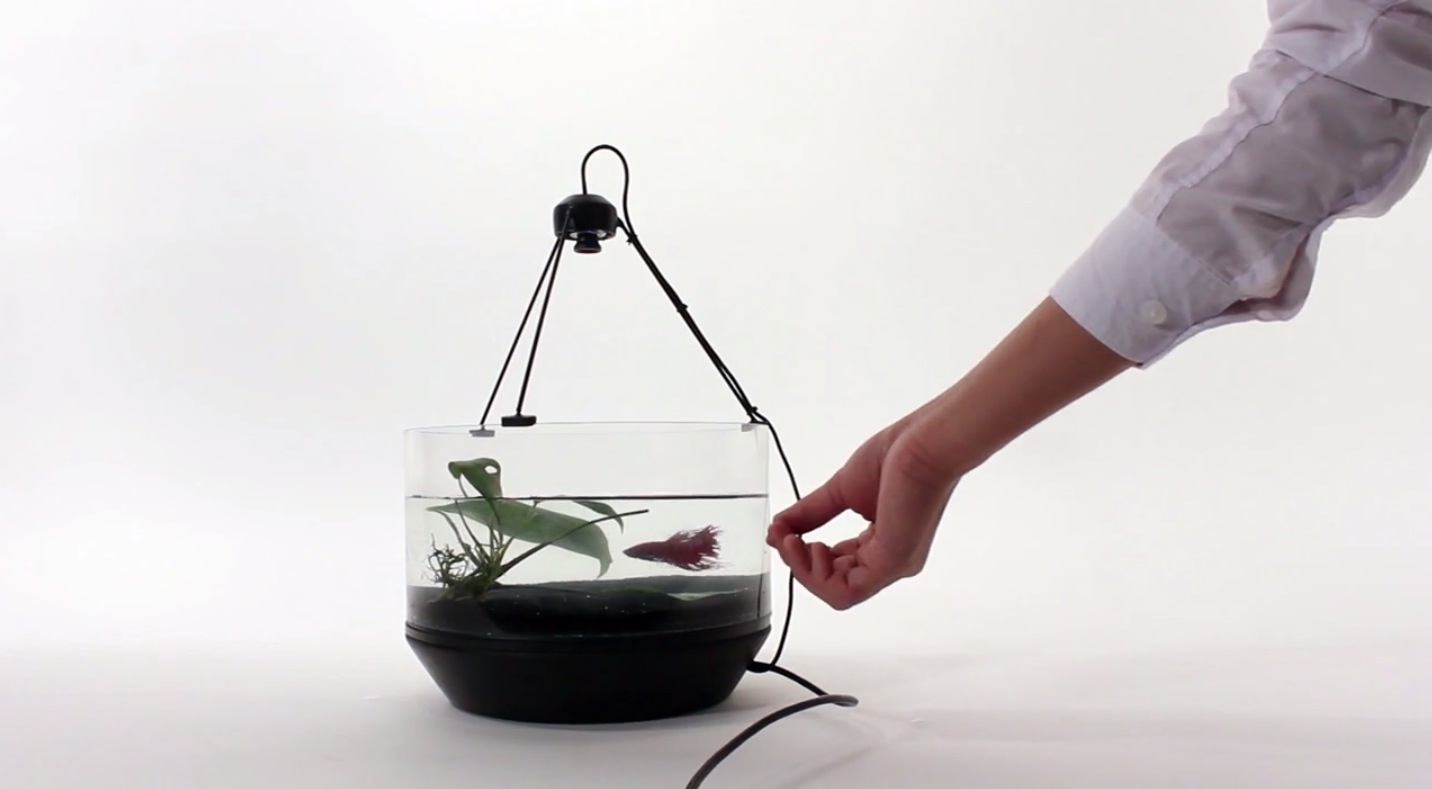
This project by Adam Ben-Dror uses OpenCV to track the position of a fish in a mobile fishbowl. It then moves the bowl based on the direction the fish is swimming, allowing the fish to roam “freely” on land.
I like this project because it is an interesting use of computer vision, and technology as a whole. It reminds me of the “reverse SCUBA suit” created by Dr. Wernstrom in the eighth episode of Futurama. While it is a similar concept, Adam Ben-Dror’s project is much more simple and elegant. I also appreciated the simple, no-frills design that was used in this project. The documentation is also, very professionally done.
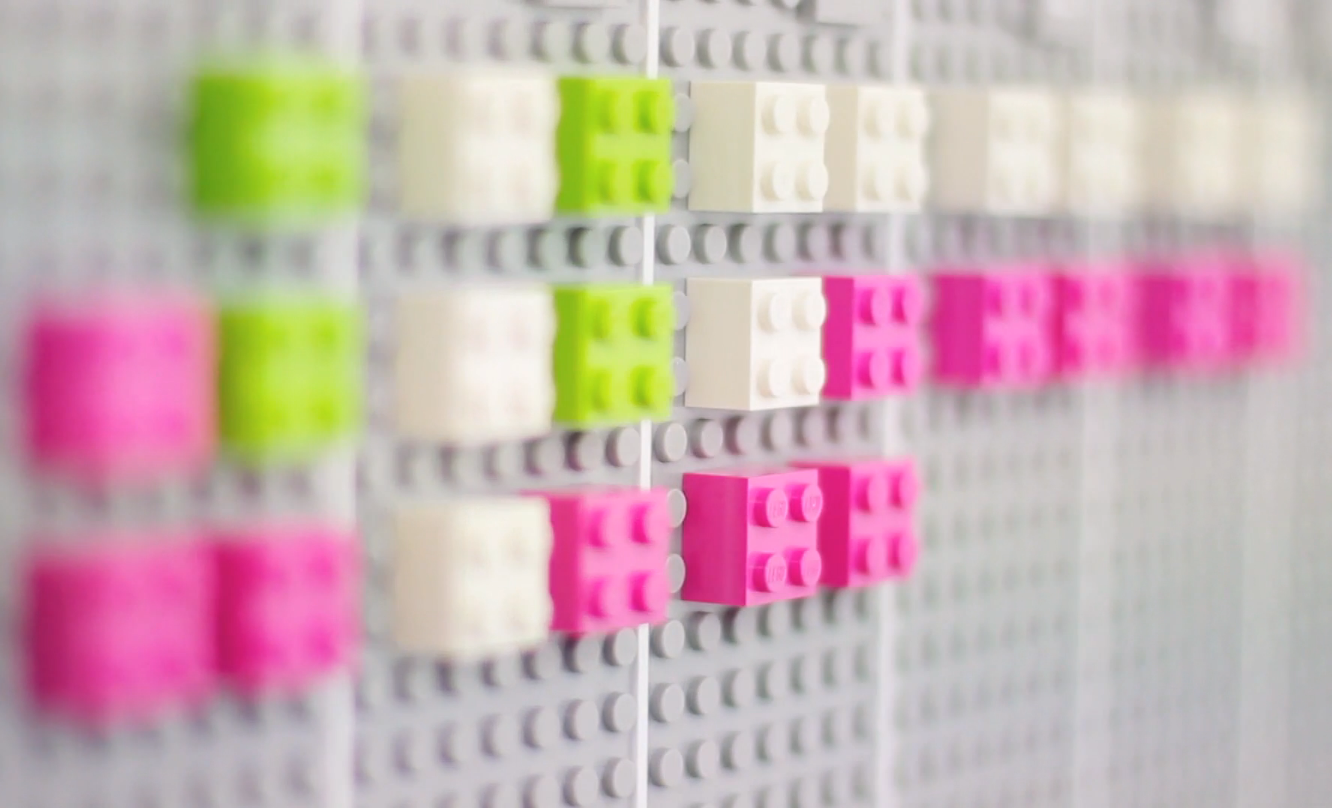
Bit Planner – A Cloud Synchronized Lego Calendar
This project created by Vitamin Design is a calendar that organizes workflow, where projects are represented by different colors, people by rows, and half-days by columns. I like it because of its simplicity and that they made an app to allow themselves to update their google calendars based on a picture of the calendar and some simple OpenCV use.
As I enjoy Legos, and am in constant need of more organization, this project really struck me. Where a simple google calendar would have sufficed, this goes beyond by adding the ability for people to interact with the schedule in the physical world (and using Legos).
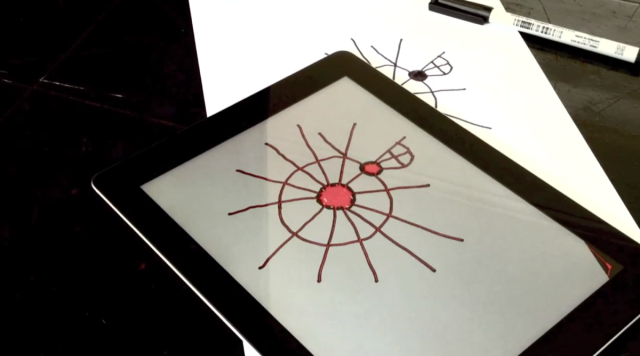
Tunetrace-Drawings to Music
Ed Burton’s app, Tunetrace, allows users to take pictures of drawings, and then creates a tune based on their shape, their topographies, and a simple set of rules. I like it because it shows another interesting use of OpenCV, and that it is an iOS app created in openFrameworks. I like to see that oF is capable of making streamlined apps for mobile devices.
I thought though that the melodies created were not very interesting. It also seemed to me that the user has no control over what tones will be created. After searching online, I found no posts of people’s tunetraces which they thought were intereseting, and this makes me assume that no one was capable of making something amazing with this system or interested enough in the system to take the time to make something to share. I would like to see a system like this that elegantly created music from a drawing but at the same time gave the user more control.