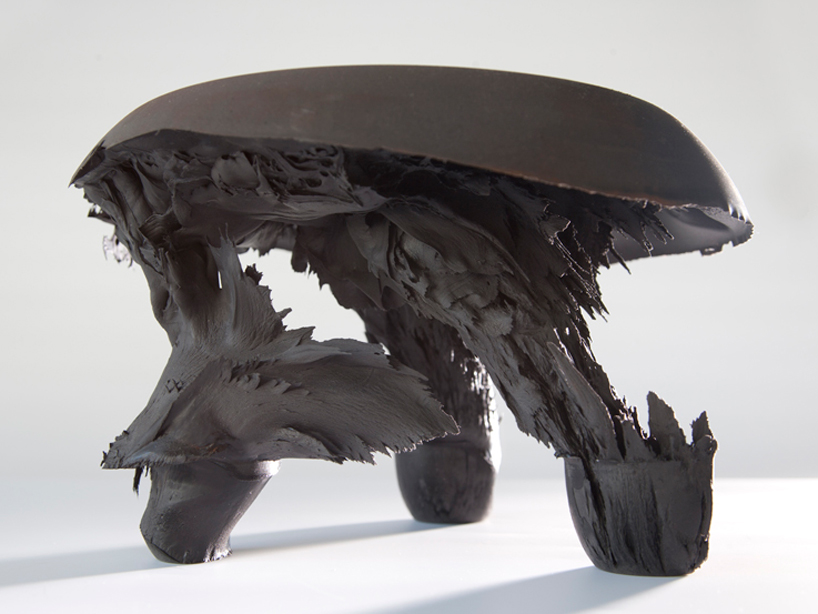
With all the discussion of software-steeped art, I felt a reactionary desire for embodiment. So I found myself attracted to projects with materiality, such as the Gravity Stool displayed above (with a making of video below). Using the forces of gravity and a very strong magnetic field, Jolan Van der Wiel crafts these unique and unusual pieces of furniture. Although I am an outsider to the world of design, I do know that chairs are almost symbolic objects. As this is my first university class in art or design, I thought my first Looking Outward could explore this prototypical example of the intersection of artistry and functionality in the vehicle of a chair. I appreciate the creative setup where elements of chance join forces with nature. I find the results a bit terrifying, with sharp edges and a stool that may or may not be able to support its user.
The algorithms alluded to in generative art, which Golan called morpho-synthesis, must have captured my imagination as the decaying ‘buildings’ seem to have both crystaline structures and traditional architectural forms. I enjoy the structural elements that jump off the canvas and am curious why the artist chose to douse his creations in one color of paint. Individuality fades in the face of erosion and time? Again escaping the world of software, these dystopian architectural paintings, created by Jerry Joran, enter and share our space. Though this time created by application of human handicraft, it is as if nature has already begun our degradation, reminding us of our impermanence.
We have explored growth through natural forces, civilization growth in conflict with natural decay, and now I show you mechanical growth in a human body. The video below is fictional and speaks of a future where we are joined with machines but they take us over from the inside. These mechanical structures have adopted the technique of viral or crystaline growth to grow from seeemingly innocuous implants that were meant to help our age-weakened bodies survive. Dystopian blends with organic generation and degradation. The story could equally be a physical metaphor for cancer or an internalization of how computer viruses might capture and transform our data. It also reminded me of our first assignment. Random numbers generating complex but aesthetically-pleasing forms based on a few rules. The results of algorithms can be dangerous as well as beautiful.
Beware of Metalosis Maligna by Floris Kaayk
[vimeo=https://vimeo.com/1192666]
A simple premise – Robotic cat ears that move autonomously, depending on your mood. Despite being more or less horrified with the specific application, it’s comforting to know that brainwave-sensing technology has reached the point where it can be applied to such ridiculously frivolous products. A different form factor, perhaps a “smart” mood ring, for example, would be preferable, or more pragmatically, light controls that dim and brighten in time with your mood. Taking advantage of a user’s mental state to automatically control a system of some sort definitely has potential, though.
Origami isn’t exactly my forte, but I do have an irrational love for papercraft, the art of exploding 3D models, printing them out on 8.5 x 11 paper, then cutting and gluing until an object takes form. This particular project finds the user creating these models based on his memory of a favorite automobile and recreating it at full scale, down to the individual widgets. There’s something really compelling to me about being to generate quite literally any form with only a printer, scissors and glue. The funny part is, 3D printers don’t inspire this same sort of devotion in me. I’m going to propose that the reason is the materiality of it all. Unless you’re scraping off layers of sand manually, 3D printing is a magical, hands-off activity. Papercraft, on the other hand, is almost meditative in its application of tedious manual labor. The human hand has a part in every fold scored, every flap glued. That said, papercraft is much more compelling when you, like this creator, generate the patterns yourself.
I’ll admit this right up front – most generative mathematical simulations bore me to tears. I just can’t get enthused, despite the mathematical sophistication or the elegance of the logic. Maybe this is why I was never a very successful architect. Anyway! THIS, on the other hand, is captivating. Not only does the visualization give a physical form to the mathematics, it does so in a beautiful visualization that manages to capture the essence of those great Olde Tymey pen renderings! It’s worth checking out the link tot he whole project page, as well. As is so often the case, some of the janky development screenshots are even more aesthetically fascinating than the finished product.
We’ll have all semester to talk about and create computational interactive art, but interactive art isn’t a medium confined to the computer. I thought I would focus my first Looking Outwards on three pieces of fantastic non-electronic interactive art.
Train:
Train by Brenda Brathwaite (2009)
Train is a board game entirely unlike anything else. Created by Brenda Brathwaite as part of a series of non-traditional boardgames, players compete to load small yellow pawns into train cars, cramming them through the too-small entrance of the cars. Each turn, players can roll a dice and either move their car forward/backward that many spaces, or add or remove that many people from their car. Instructions, read out of an antique type-writer, are terse and open to interpretation, including the victory condition: “Train is over when it ends.” The true message of Train is only revealed when a player’s train reaches the end of its track, and that player may read the card which tells them their destination: Auschwitz.
When the message of the game is revealed, the mechanics take on a new, sinister context, one which forces the player to think about the consequences of their actions.
Self-Centered Mirror:
[youtube=”https://www.youtube.com/watch?v=X1ZaSEbO4iY”]
The Self-Centered Mirror, a piece of interactive sculpture by Daniel Rozin, is a series of 34 cunningly arranged mirrors that will reflect your image and only your image, stripping everyone else out of the room. Due to the nature of the installation, participants generally will make unusual gestures and poses, which are from their gaze private. The artist refers to it as “…lift[ing] the last obstacle from [humanity] in the quest to total narcissism.” Though Rozin didn’t take any, I would have liked to see as part of the documentation video footage of people admiring themselves in the mirror.
The Compass Table:
Compass Table by Dunne and Raby (2001)
The Compass Table is a novel piece of furniture design by Dunne and Raby as part of The Placebo Project. A wooden table inset with magnetic compasses, The Compass Table allows us to see the effects of electromagnetic fields. When an electromagnetic field is generated (such as by a cell phone), the compasses twitch and move. In this way, the table shows viewers the invisible signals that surround them, exposing an entire world that exists right between our noses.
Communion is a video installation that projects a grid of sound-reactive critters over four walls of a rectangular space. Each dynamically-generated creature dances to the rhythm of a musical accompaniment. I appreciate the artist’s careful balance between randomness and order. While skeletons vary in form and motion, they are united by color and a clear organizational matrix. One thing the piece lacks is interactivity. Although it directly addresses the connection between sound and motion, it leaves no opportunity for the audience to explore this connection themselves. If installed at a rave or concert, Communion could really shine.
Tele-Present Water – David Bowen
Tele-Present water is a kinetic sculpture consisting of a metal grid suspended from an array of servo motors. The grid moves to mimic the frequency and intensity of the ocean at a remote location. Tele-Present Water effectively contrasts the mechanistic and the ephemeral. It pits an industrial aesthetic against effortless motion to great effect. However, the tele-presence aspect is perhaps an unnecessary complication. If instead its motion was programmed manually, like a marionette, the artist could explore new aesthetic ground.
Thicket – Joshue Ott + Morgan Packard
Thicket is an iPad app for creating generative music. A simple backbeat is augmented with lead synths and percussion hits in response to multitouch gestures. Thicket makes music creation intuitive. It enforces enough structure that anything sounds good, while still empowering the user to feel control. The experience is generally consistent but could benefit from further audio-visual feedback. The direct connection between gesture and sound is not always evident. Judicious use of color is one way the artist could attempt to reinforce these connections.
Comments Off on Nick Inzucchi – Looking Outwards – 1